
Contemplating Grammar
by Andrew Pudewa
(This article first appeared in the June 2012 issue of The Old Schoolhouse Magazine®.)
It seems that the pattern of t...
Read More


I am excited to share a new way to use Fix It! Grammar that I have discovered this year. Starting with Book 1, The Nose Tree,... read more
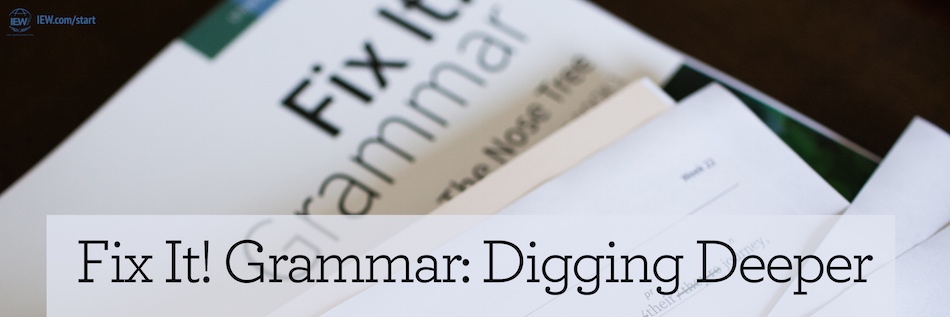
Last week we answered some of your general questions about Fix It! Grammar. This week we thought we’d take a closer look at each of the books in the series and go a... read more
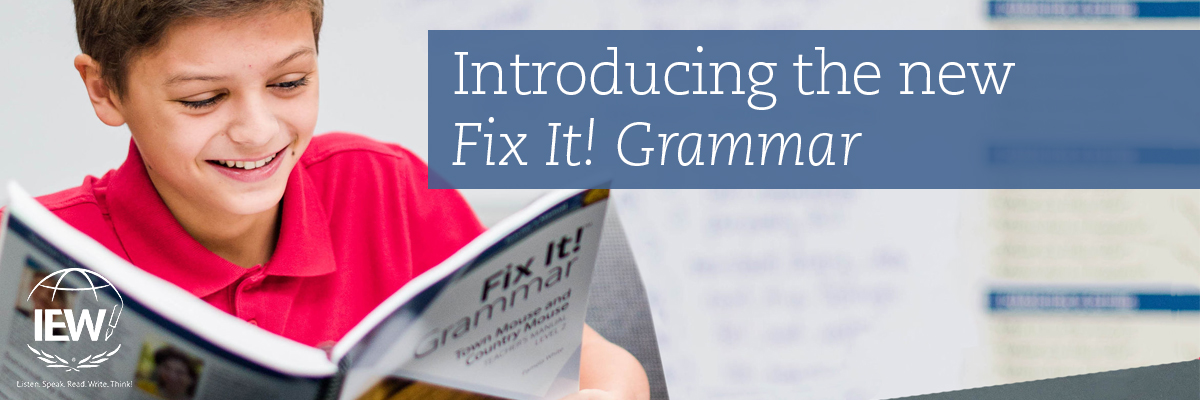
Since 2007, teachers and students have delighted in Fix It! Grammar. One of the most appreciated outcomes from using the program has been the ability students have gained to apply their new grammar... read more

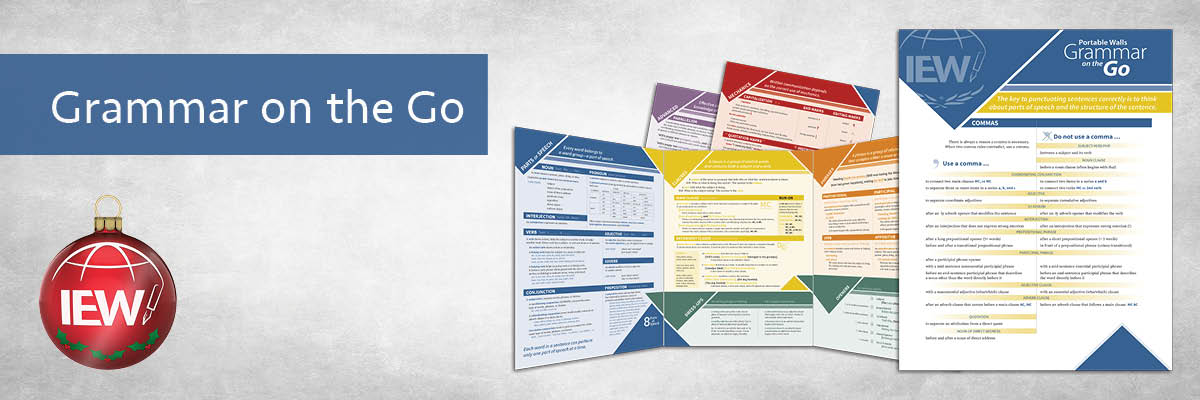
On Day 4 of IEW’s Twelve Days of Christmas Giving, IEW is giving the perfect gift for helping new and veteran IEW families and teachers tackle the often-daunting task of implementing grammar with... read more
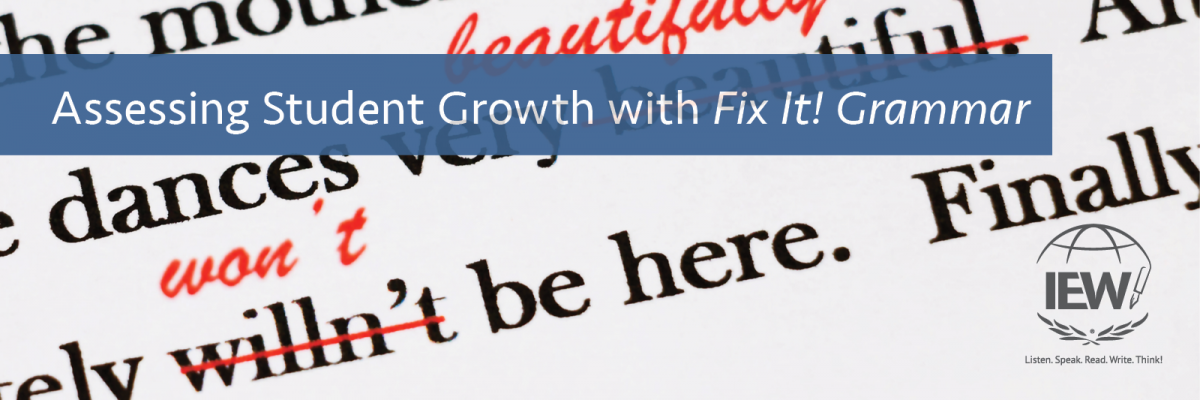
Teachers in school classrooms need opportunities for assessing student growth whether by traditional tests or by some other assessment. Educational assessments are methods of measuring students' learning and progress. They are essential tools... read more
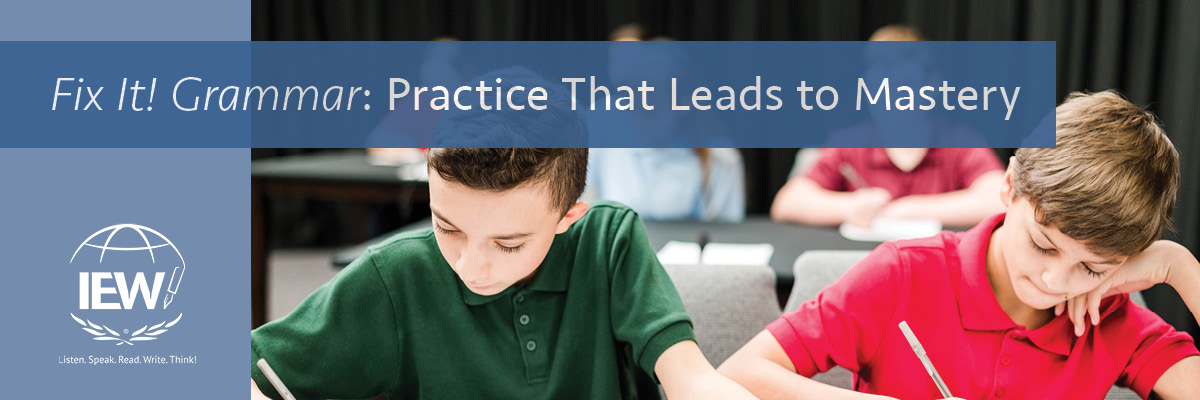
Practice, practice, practice. Mastery of any skill takes practice—lots of it. Musicians repeat scales and basketball players run drills. Until the skills have been practiced enough to gain muscle memory to perfect the... read more

Happy New Year! For the first podcast of 2022, Julie Walker invited Denise Kelley into the recording studio to discuss the exciting launch of the fourth edition of Fix It! Grammar. As Senior... read more
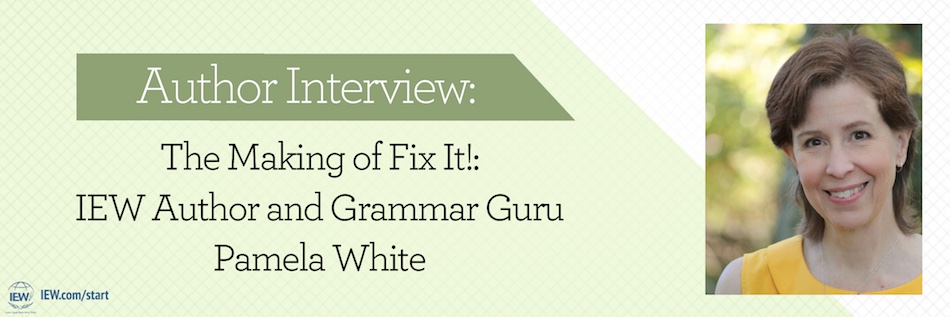
Pamela White is IEW’s “grammar guru.” Author of the popular Fix It! Grammar series and IEW’s online department head for Level C classes, Pamela recently sat down with us to talk about how she... read more

The three R’s—reading, writing, and arithmetic—are generally agreed to be the foundation upon which all other subjects, including science and history, are laid. But buried within the writing component is the thing we... read more
“Grammar is important. Language should be precise. We must teach it well. However, let us not be confused or distracted by feeling a need to teach formal grammar too soon to children who... read more
As educators we have a lot to keep track of. Planning lessons, grading, evaluating progress, and communicating with students and parents require our time and attention. Now add to these tasks the typical... read more

When teachers logged into their IEW® Gradebook accounts this July, one comment summed it up best: “It just keeps getting better!” That’s because IEW Gradebook's latest 2.0 update is more than a polished... read more

Do your students hate grammar? Do they think it’s boring, confusing, or pointless? Do you? If so, I want to recommend some fantastic picture books that will help spark an interest in even... read more

Why watch IEW's parent/teacher training course? Have you ever wondered why IEW’s core product is a parent/teacher training course? Busy homeschoolers often ask, “Couldn’t I just watch the student DVD courses with my children... read more

IEW’s Customer Service team often receives grammar questions from customers. Most often these questions have to do with why something is marked a certain way in Fix It!® Grammar. Occasionally, we are asked... read more
If you missed the gifts given for Day 12, you can still access the digital 2023 edition of the Magnum Opus Magazine. On the twelfth and final day of IEW’s Twelve Days of Christmas... read more
The English language is a challenging one to learn. This difficulty primarily stems from the fact that English is a melting pot of words that come from other languages. While there are influences... read more

This year at IEW, we are focusing on furnishing the mind. Just as we arrange furniture in our homes to create a comfortable and aesthetically pleasing environment, the mind too requires intentional furnishing.... read more
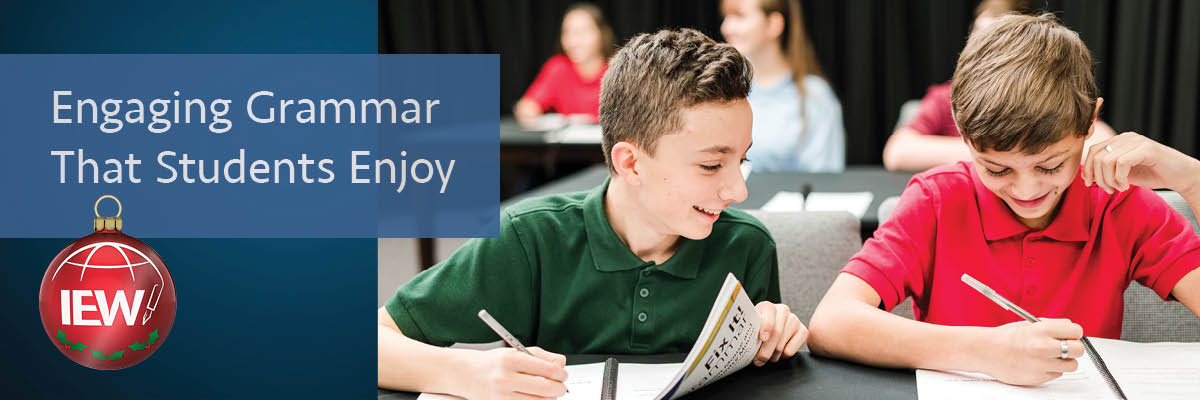
If you missed the gifts given for Day 4, you can still access these resources: Free Grammar Lessons Podcast Episode 228: The Great Grammar Give and Take, Part 1 Podcast Episode 229: The Great Grammar Give... read more

Words are funny little things. Each letter matters. Words that sound alike, called homophones (homo = same, phone = sound), have different spellings and different meanings. As such, they are easily confusable and... read more
“I have come home at last! This is my real country! I belong here. This is the land I have been looking for all my life, though I never knew it till now...Come... read more
As a homeschooling mom, co-op teacher, and now a classroom teacher, I have found that Fix It!™ Grammar is the most practical and painless way to teach and learn grammar. In Andrew Pudewa’s... read more
Everyone has opinions about grammar. Because grammar is foundational to writing, IEW is often asked about the teaching of grammar. In his talk But . . . but . . . but .... read more

In her 1977 article “Writing as a Mode of Learning,” Janet Emig states, “Writing serves learning uniquely because writing as process-and-product possesses a cluster of attributes that correspond uniquely to certain powerful learning... read more

Earlier this year you sent a box of doughnuts for the staff break room. Now with the end of the school year approaching, you have already purchased a gift bag full of themed... read more

March is National Grammar month, so for this month we have been highlighting the topic in our blog as well as on Facebook. Our podcast is no different, and in Podcast Episode 181,... read more
Any time or anytime? Every day or everyday? A while or awhile? There are so many of these types of homophones. They’re easy enough to use in speech, but have you ever wondered... read more
Although speaking English comes naturally to most native speakers, writing it can sometimes feel fraught with potential pitfalls. If you have ever paused after writing a word or a phrase and wondered if... read more

Over the decades that Andrew Pudewa has been speaking to teachers and parents, he has heard many of them make one of these two statements: I just want my students to enjoy writing. I just... read more

I love the sound of children giggling as they work together to choose a quality adjective or come up with a witty alliteration. If you are planning to teach IEW in a homeschool... read more

Of the skills that produce a well-written essay, IEW’s top two, structure and style, are certainly key linchpins. Equally important, however, is the often misunderstood art of grammar. If you express a worthy thought... read more

These days, it seems that I am perpetually in my home. I suspect many of us are. Being in my home more, I find I am eating more meals in my home as... read more
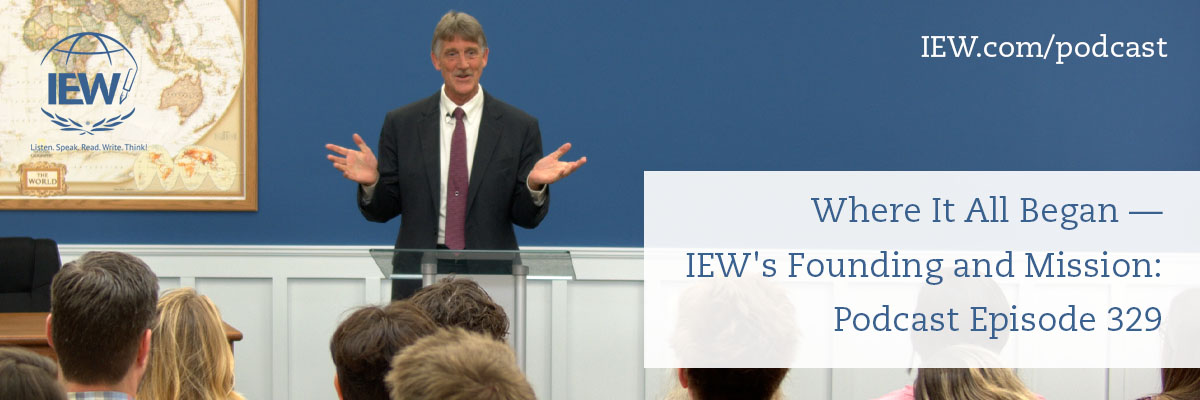
Andrew Pudewa is the founder and director of the Institute for Excellence in Writing and has been teaching writing for over thirty years. What some people might not know, however, is that Andrew’s... read more
In this week’s podcast, Episode 304, Andrew Pudewa and Julie Walker discuss grammar and its role in the writing process. Relating the findings of research, Andrew shares that teaching grammar explicitly was not... read more

Enjoy Jill Pike's concrete response to a parent’s recent request for help regarding the art of invention. Inventive writing is difficult because it begins with a blank page—what to write? This is why IEW... read more

In the current episode, podcast Episode 229, of The Arts of Language Podcast, Andrew Pudewa and Julie Walker continue their conversation about grammar, this time focusing more specifically on Fix It! Grammar. Beginning... read more

The summer months are a period of preparation for educators and teaching parents. Curriculum considerations and decisions dominate during this time. One area where our customer service team fields a lot of questions... read more
by Linda Mikottis and Jean Nichols In part one of this series, we described the importance of a multi-sensory approach to language development and how IEW’s Structure and Style™ key word outline method incorporates... read more
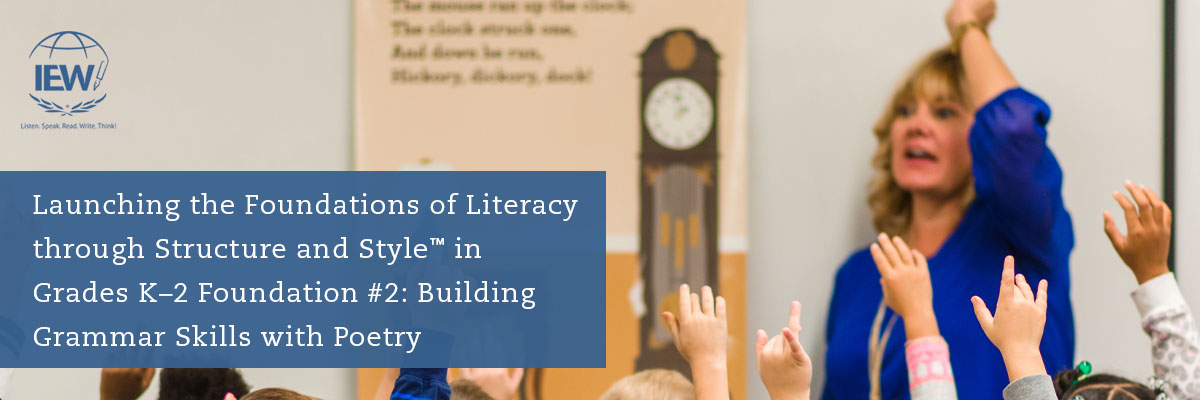
In Part 1 of this series on IEW’s primary materials, we discussed poetry as a powerful tool in language development, specifically in building language skills and boosting reading comprehension. Part 2 examines the... read more
Look closely at the title. Why is there a colon? How does a colon differ from a semicolon? Fix It! Grammar has the answers, and students who use the grammar program will not only... read more
While Andrew was out of the office this past week, Julie invited Denise Kelley into the podcast recording studio. Because Denise serves as IEW’s senior project manager, The Arts of Language Podcast has... read more
An essential part of using IEW’s stylish sentence openers is knowing when and where to add commas. In response to a customer question, Pamela White, Accomplished IEW Instructor and author of the fabulous... read more
In many ways, the high school years are a staging ground for adulthood. For some students high school represents the culmination of their formal education. For others the high school years are preparatory,... read more

School has started, and Mrs. Jones’s students are steadily improving as they move through the structural units. They’ve also learned the -ly adverb, who/which clause, and strong verb dress-ups. All is going well!... read more
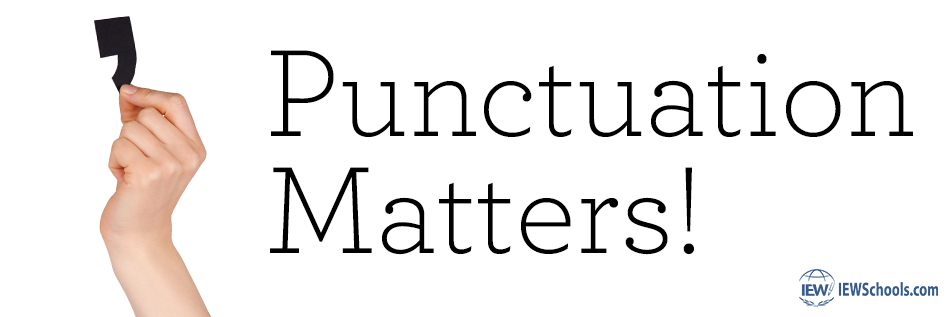
Many of us have seen the meme, Let’s eat Grandma! It’s a powerful reminder how a tiny little punctuation mark, the comma, imparts so much significance to a sentence. A serene little comma... read more
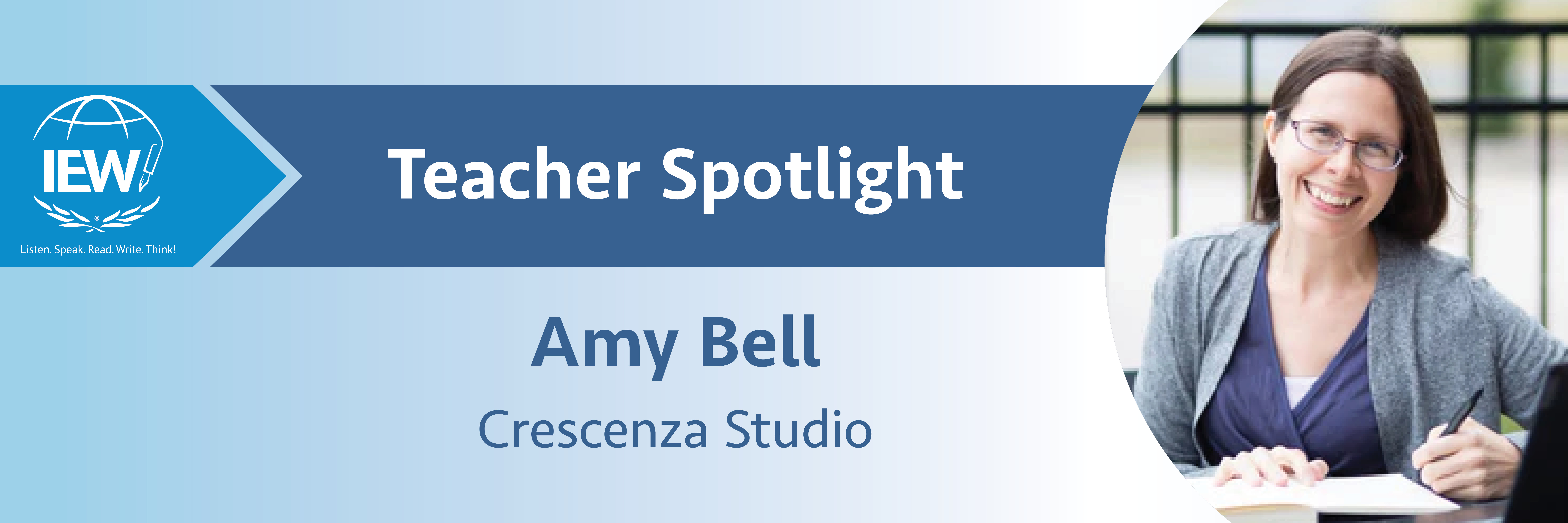
Amy Bell is the founder of Crescenza Studio, where she and a team of teachers offer private tutoring, writing classes, and other courses covering various subjects. Amy’s background as a writer and music... read more

Last night we launched our first “Facebook Party,” an event that included over five hundred parents and educators. Andrew Pudewa and other IEW commentators were among the participants as they answered some challenging... read more
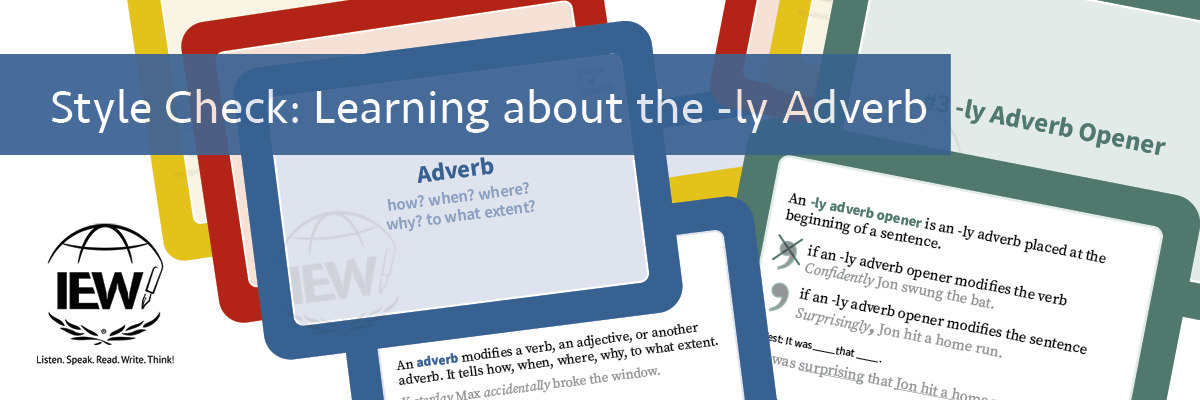
In IEW’s list of stylistic techniques, the first dress-up students learn and practice is the -ly adverb. One of the eight parts of speech, adverbs modify (add information to) verbs, adjectives, or other... read more

# Meet Rachel Averitt. Rachel was homeschooled through the sixth grade and then began attending a small Christian school in Oklahoma called Mingo Valley Christian, where she first encountered writing with IEW. This past spring... read more

A common question that IEW’s customer service team receives is “What is the difference between the Structure and Style® for Students packages?” Trying to discern the differences from the pictures on the website... read more

With the final day of IEW’s Twelve Days of Christmas Giving event only recently completed, we wanted to take a moment to reflect on the days and to thank all of you who... read more
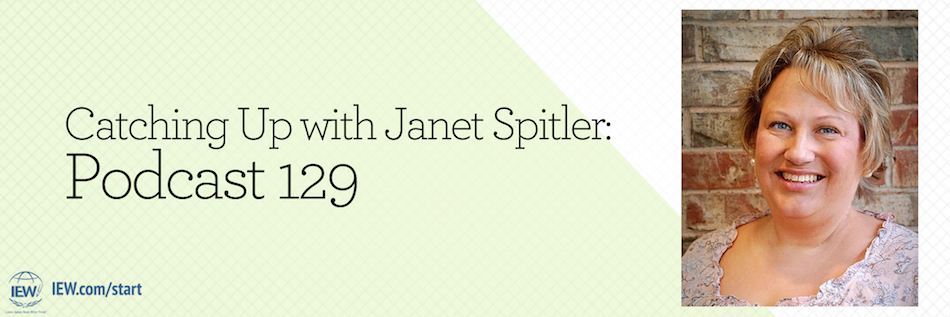
# # In our latest podcast, Julie Walker had the opportunity to catch up with Janet Spitler, and that’s no easy feat! Janet is IEW’s Senior Educational Consultant for the Schools Division and is devotedly... read more

Many of our customers reach out to customer service as their student approaches high school. They want to be sure that our materials will count for a language arts credit on a high... read more
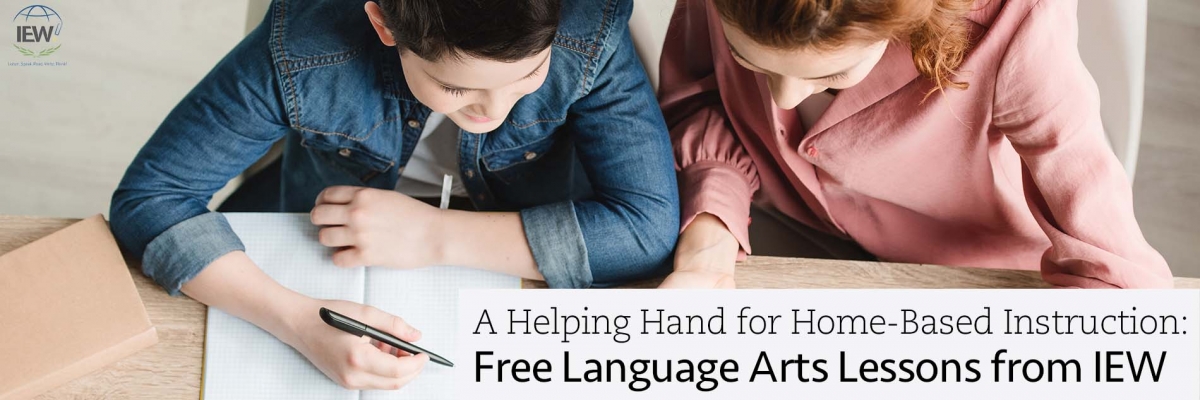
With all that is happening in the world and across the United States, IEW wanted to do what we could to help in some small way. That’s why today’s post is a bit... read more

One of the elements in the stylistic techniques list is the strong verb. A strong verb is a verb that works in place of a more mundane alternative. The strong verb provides a... read more

With the arrival of June, many parents are beginning to plan in earnest for the upcoming school year. If you have thought about having your students participate in an online class, we would... read more
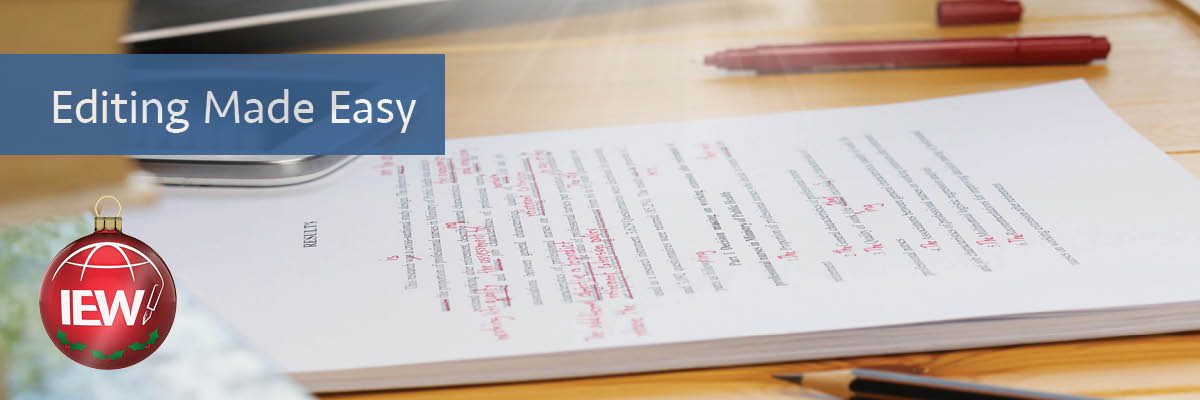
If you missed the gifts given for Day 9, you can still access these resources: Podcast Episode 333: Letter to the Editor “How do I grade my student’s writing?” is a question that IEW receives... read more
In a blog post last week, I introduced the strong verb dress-up. The third dress-up to be introduced, the strong verb constructs a clearer visual image of the action in the reader’s mind.... read more
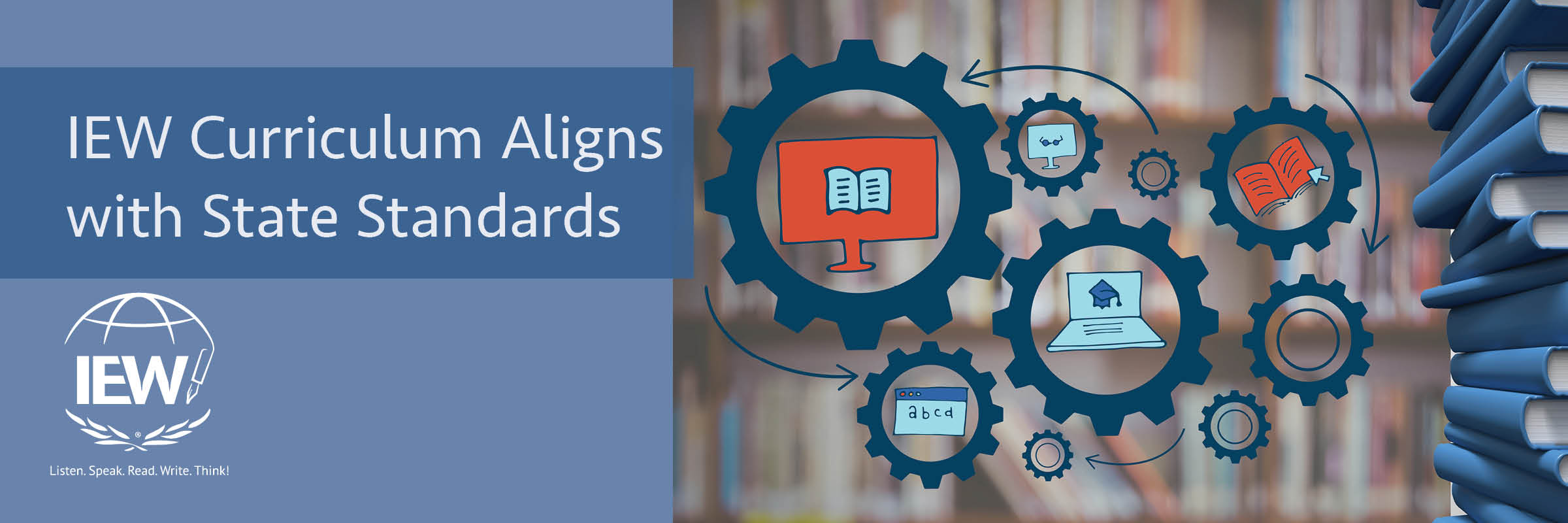
Administrators, curriculum directors, and schoolteachers often call IEW’s Schools Department asking if our curriculum meets state educational standards. Some schools or charter schools are not allowed to recommend items if they are not... read more

Occasionally we get calls from parents of older children who are just starting out with IEW. They are worried that their students are starting too late for it to really work well. Alayna... read more
Homophones, words that sound the same but that have different spellings or meanings or both, can be tricky to remember. Some of the earliest homophones students learn are its and it’s as well... read more
Students commonly struggle to mark -ing words correctly in papers and in Fix It! Grammar. Students who ask the right questions can know with certainty if an -ing word functions as a verb... read more
Apostrophes are important little punctuation marks. Most people know that they can be used in different ways. For example, one of their functions is to indicate that letters or numbers have been removed:... read more
IEW® writing method works in a variety of environments. Many students encounter it in their homeschools. Others, though, learn to write using IEW materials in different settings. Carly Torres first experienced IEW at... read more
We are thrilled to share with you this fabulous news: High school students can now earn dual credit for both Comp I and Comp II (a total of six credit hours) when they... read more

Teaching writing would be my favorite job if it weren’t for grading. When a student hands in a composition and a teacher sees all the mistakes, how does one avoid the inevitable frustration?... read more

Investing in IEW’s Premium Membership is an investment in yourself as well as your students. Several fabulous perks have been added to the already robust compendium of support for teachers of Structure and... read more

In Podcast 164 Andrew Pudewa and Julie Walker began a discussion about the four forms of relevancy. In the first podcast on this topic, they focused on the highest form of relevancy, intrinsic... read more
At IEW we want the courses we provide to be ones that will excite and engage both you and your student. In order to help support you as you teach your children, we... read more

Which IEW courses will help prepare your students for writing at the collegiate level? Most colleges expect students to be able to write proficiently. Across academia, professors often assign essays to gauge their... read more
We are thrilled to share with you this fabulous news: High school students can now earn dual credit for both Comp I and Comp II (a total of six credit hours) when they... read more

By now you’ve likely heard the buzz about Structure and Style for Students, IEW’s new video-based student course. Every day, our customer service team receives calls from teachers considering which level of the... read more
Lay versus lie. These two verbs perennially perplex even the most astute grammarian in terms of correct usage. Hopefully in today’s blog post, we can help you feel more confident as you use... read more

After students learn how to insert a -ly adverb, the next stylistic technique they learn to construct is a who/which clause, a type of adjective clause. In grammar, a clause has two parts:... read more
The month of October marks National Learning Disabilities Month as well as Dyslexia Awareness Month. This year on IEW’s blog, we are commemorating these events in a number of different ways. Throughout the... read more
In June IEW presented its second annual Online Writing Conference. Attended by people from all around the world, the conference offered education and support for teachers, administrators, parents, and students. In this week’s... read more
We live in a time where there are many options for educating our students. Since the pandemic more and more families have chosen to educate their children in nontraditional settings. Many of these... read more

Believe it or not, it is almost time to start back to school. In one form or another, whether it be traditional brick and mortar, a hybrid approach, online, or at home, the... read more
It has been a tremendous blessing to have discovered IEW early on in my homeschooling journey. With over twenty-one years in the trenches so far, I am still homeschooling... read more

Celebrate Episode 500 of the Arts of Language podcast with Andrew Pudewa and Julie Walker. There is so much to celebrate that it took three parts to talk about it all! In part one... read more
Behind every great writer is a great editor. This holds true for nearly all great authors, and for us at IEW. IEW has a small but sharp team of editors who work on... read more

This summer, our IEW team grew by a few more people—college interns who have been helping in a variety of ways around the office. One of these special people is Kaitlyn Butts. Enjoy... read more

Recently Dr. Nicholas Ellis paid a visit to IEW’s campus in Bixby, Oklahoma. Dr. Ellis is the founder and CEO of Christian Halls International (CHI), and Andrew and Julie were honored to welcome... read more

Registration for Fall 2025 opens April 1, 2025. IEW® Online, which started in 2011 with just two instructors and a handful of classes, is not just another online writing class. Our foray into the... read more

As part of IEW’s continued commitment to providing parents and teachers with help for the journey of training students to be confident and competent communicators and thinkers, we are presenting a series of... read more

This past Saturday, people from all around the world gathered together virtually to participate in IEW’s online writing conference, From Imitation to Innovation. It was a day filled with inspiring instruction and useful... read more
Whether you use one of IEW’s Writing Across the Curriculum courses or a Structure and Style® for Students video-based course, it is a win-win for your students. While both use a spiral method... read more

Whether during summertime or school time, teachers and parents are busy. Inevitably, there’s always another errand to run, room to tidy, or event to attend. With all of the activities vying for our... read more

In the somewhat musty memories tucked into the corners of my mind, I can vaguely recall my thoughts about homeschooling before I took the plunge. Perhaps I had a bit of hubris, but... read more
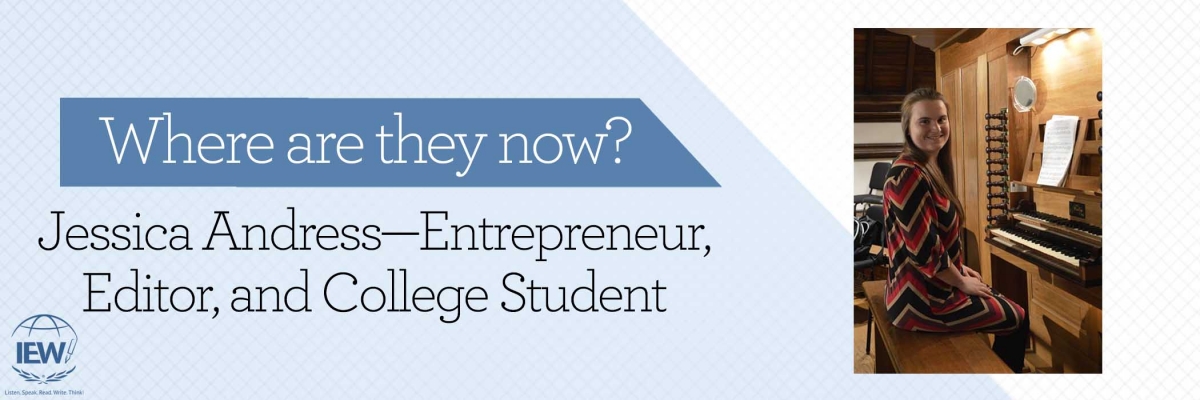
Our latest “Where Are They Now Student,” Jessica Andress, is a bit of a Renaissance gal. At her young age she has done a number of interesting things, including serving as a church... read more
F. Scott Fitzgerald had Maxwell Perkins. For that matter, Ernest Hemingway did as well. Harper Lee had Tay Hohoff. While Fitzgerald, Hemingway, and Lee are well-recognized authors, you likely are unfamiliar with the... read more

In teaching we often focus on how or what students write: the correct answer, the polished sentence, the completed paragraph. The deeper question—the one that shapes critical thinking—is why. A powerful way to... read more

A recent blog post discussed the different functions that a participle ending in -ing can have. More confusion may arise when a participle ends in -ed. A past participle is formed by adding... read more

In the very first lesson of the very first level of Fix It! Grammar: Level 1 Nose Tree, students are asked to select the correct word from among three homophones: there, their, and... read more

IEW is taught across homes and schools all around the world. Often it is a teacher or parent who guides students through the IEW approach to writing, but tutors who meet with students... read more

“We now must exhort each other; let us continue to train our students in the use of this great weaponry—the skills of written and spoken English, so that when the crises arise, we... read more
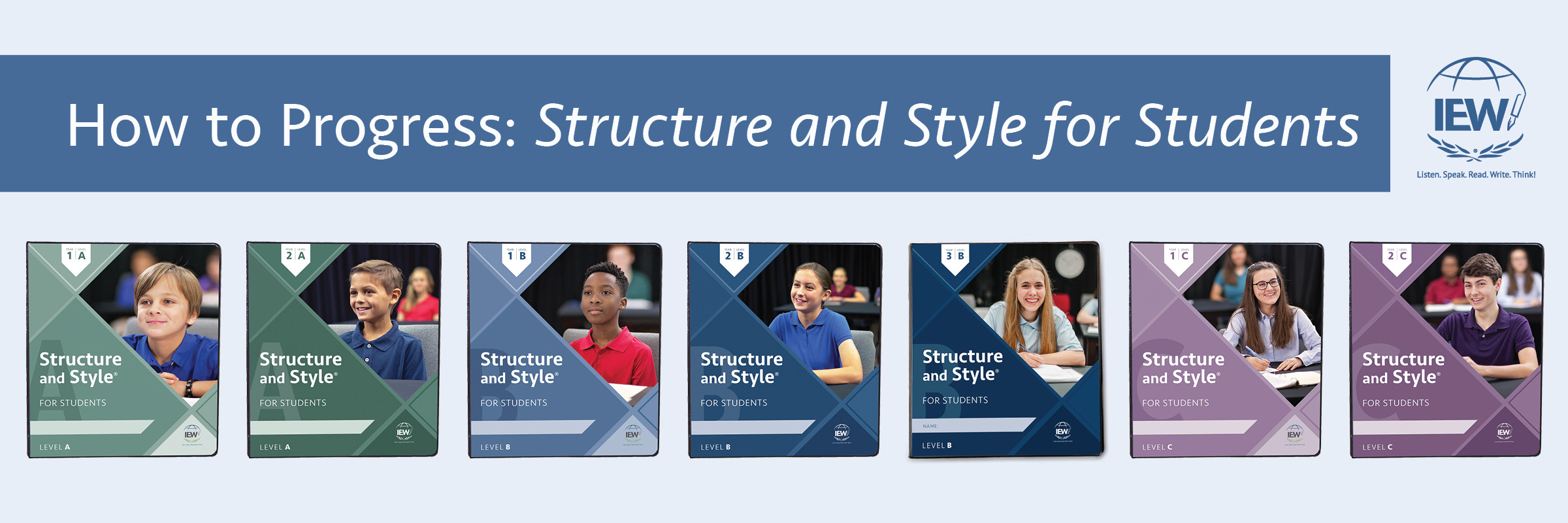
Structure and Style® for Students (SSS) video-based courses build on each other. Although many begin at Level A, older students who have used other curricula may begin at Year 1 of Level B... read more
The humble hyphen ( ‐ ) is a subdued punctuation mark indicated by a short dash line. It serves a number of purposes grammatically, many of which we will take a look at... read more
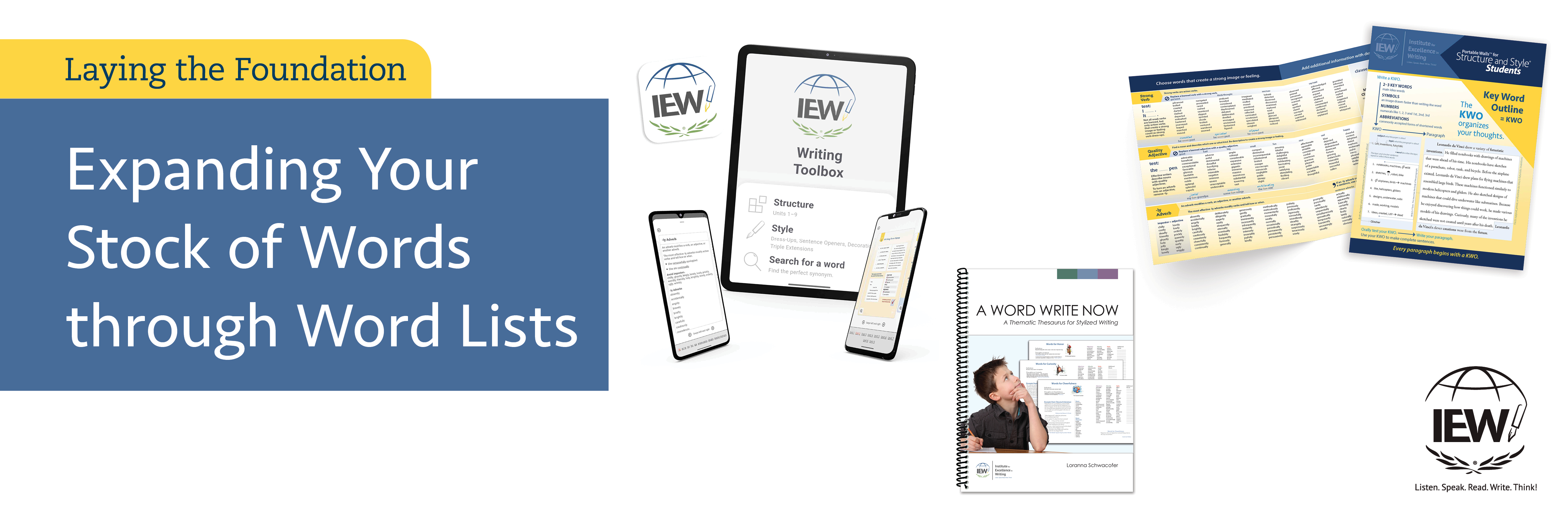
“For there is no doubt that I have lots of words inside me; but at moments, like rush-hour traffic at the mouth of a tunnel, they jam” (John Updike). Some students are like... read more
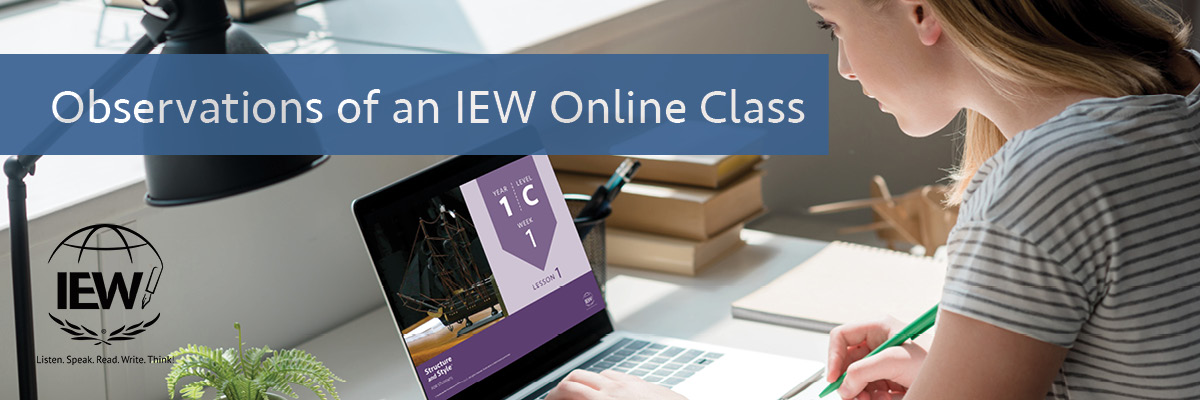
IEW Online classes are a perfect option for students who want to work through the Structure and Style for Students program but whose parents would prefer someone else to review the students’ work. The... read more

From time to time we enjoy highlighting former structure and style students to showcase their achievements both academically and professionally. Students who learn this writing method are able to confidently use the skills... read more
Parents and teachers who use IEW’s approach to teaching writing love it. Structure and Style®️ provides the direction and framework, making the job of teaching writing concrete and enjoyable for instructor and student... read more
Recently in IEW’s official Facebook Group, mom Marcela B. wrote a post in which she explained how valuable she found the teacher training she received in Teaching Writing: Structure and Style to be.... read more
Every year, new words are added to the dictionary. In 2018, for instance, words like “bougie,” “bingeable,” and “predictive” were added by Merriam-Webster. But did you know that behind the scenes there is... read more

“People laugh at me because I use big words. But if you have big ideas, you have to use big words to express them, haven't you?” Anne of Green Gables (L.M. Montgomery) Throughout this... read more

Recently we had the opportunity to catch up with one of the Level A Structure and Style Students along with his mother. Benjamin participated in both years of the Level A course, and... read more

As a mom of two students who participated in the filming of IEW’s new Structure and Style Students, Jenny observed first-hand the difference that Structure and Style made in her boys’ writing. Caleb... read more
Value. As professionals and parents, we yearn to find value not only in the way we teach our students, but also in the materials we purchase to assist us in those efforts. And... read more

Frederick East Classical, a relatively new homeschool cooperative, is taking central Maryland by storm. In its inaugural year alone, many families flocked to it, filling it to capacity. Structured using a classical approach,... read more

“Wow, that’s a big investment.” Whenever I see this comment online, I am compelled to jump in and offer my story. It began in the early 2000s. Although I had yet to hear of... read more

The year 2020 has certainly been extraordinary. In early spring we were plunged into a worldwide pandemic that we are still trying to navigate. In response to the interruption of schools and the... read more
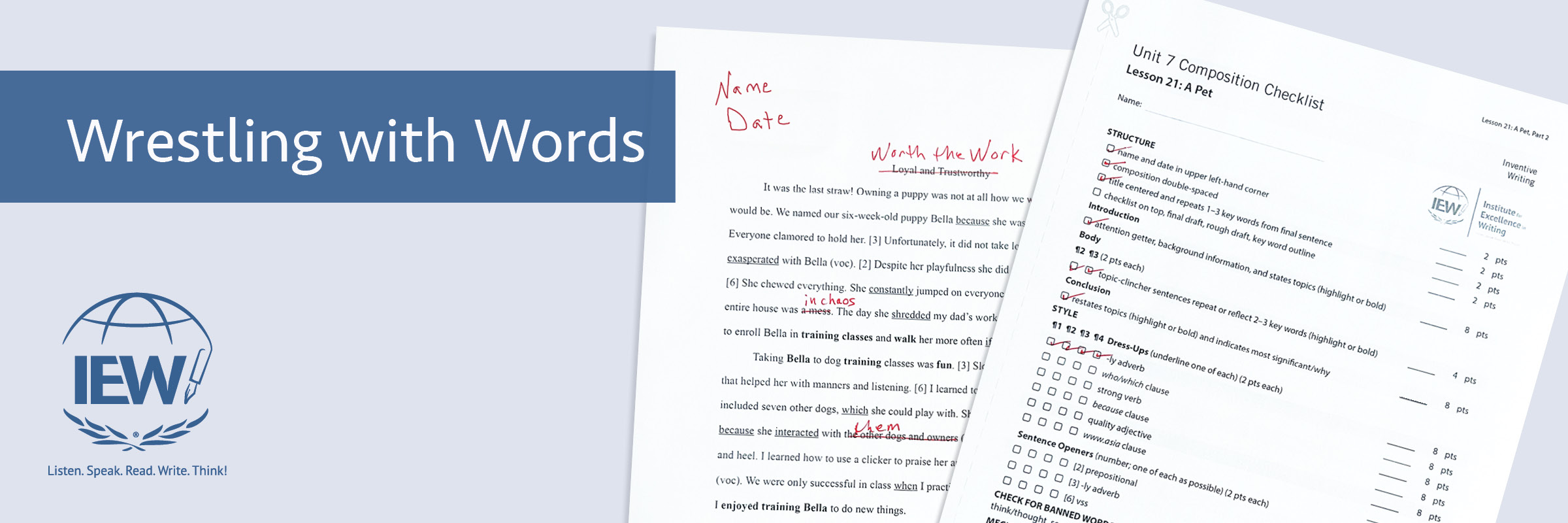
“Why do I have to underline the dress-ups?” Any parent or teacher who has used the Structure and Style® methodology for any length of time has undoubtedly heard these words, usually in a... read more
It is said that English is one of the hardest languages to learn. It breaks its own rules more than it follows them, and the rules it does follow can be confusing. However,... read more

IEW’s pathway features a great progression of coursework to help your students develop their writing skills, but those are not the only courses IEW has. Additionally IEW offers materials that support all components... read more

Spring is in the air. How can you tell? Birds are building nests, trees are beginning to bud, and conferences for teachers and parents are starting to occur all over the country. Andrew... read more

For many years there have been two primary diagnostic exams for students preparing to attend college, the SAT® and the ACT®. Now, though, there is a new exam available that is an even... read more
Every ten episodes of The Arts of Language Podcast is extra special. On those occasions, Andrew takes the opportunity to answer your questions that come in through Podcast@IEW.com. It’s an enjoyable podcast to... read more

Now that we are in the holiday season and are rapidly approaching the mid-point in our school year, it’s a great time to throw a party—an IEW party, that is! Over in our... read more

My connection with the Lee family began with a phone call. One of IEW’s customer service agents spoke with a woman about her daughters who were interested in becoming accredited IEW instructors—at the... read more
by Linda Mikottis and Jean Nichols In the previous post in this series, we compared traditional methods for teaching grammar with those used in IEW’s Structure and Style™ process that are more successful and... read more

With podcast Episode 285 Andrew Pudewa concludes recounting the accumulated twenty-year tally of his “Best Book of the Year List.” To listen to the first two episodes, visit the links here for Episode... read more
In Andrew’s classroom he requests that his students hire an editor to look over and mark up their rough drafts prior to turning them in. In fact, Andrew has even written a letter... read more
We recently received this powerful testimonial from Johanna Mackin, a middle school teacher in Murfreesboro, Tennessee. Hoping that it will inspire other teachers, we are pleased to be able to share it with... read more

As educators continue to adjust to life COVID-19, the difficult reality is that 5-day-a-week traditional schools that were teaching in person may once again be moving to virtual instruction. I taught for over... read more

Summer. It’s a season to rest and recover from the hard work of being an educator, right? Whether you are a five-day-a-week teacher in a brick and mortar school, a co-op facilitator teaching... read more

On Day 3 of Twelve Days of Christmas Giving, IEW is giving you a three-week sample from Writing Across the Curriculum. Be sure you are registered for the event to receive the email... read more
What is an essay? How is it distinguished from a report? Why is it important to teach our students how to write persuasively? And how do we help our students transition from writing... read more

Idioms. We use them in our everyday conversations, but because they are so ingrained into our language structure, we rarely stop to give them a thought. If you had asked me to define... read more
On Day 6 of IEW’s Twelve Days of Christmas Giving, we offer several gifts to help with your youngest learners. Be sure you are registered for the event to receive the email with... read more

On Day 6 of IEW’s Twelve Days of Christmas Giving, we offer several gifts to help with your youngest learners. Be sure you are registered for the event to receive the email with... read more

School’s out! Time to put away the books and forget about school for a few precious, sun-drenched, fun-filled months, right? Wrong! And in Podcast Episode 194, Andrew and Julie talk about why. As... read more
Which words correctly fill in the blanks? Fifty states ________________ the Union. (compose, comprise) The Supreme Court typically ______________ nine justices. (composes, comprises) Do you know the answers? If not, you’re in good company. Truth be... read more
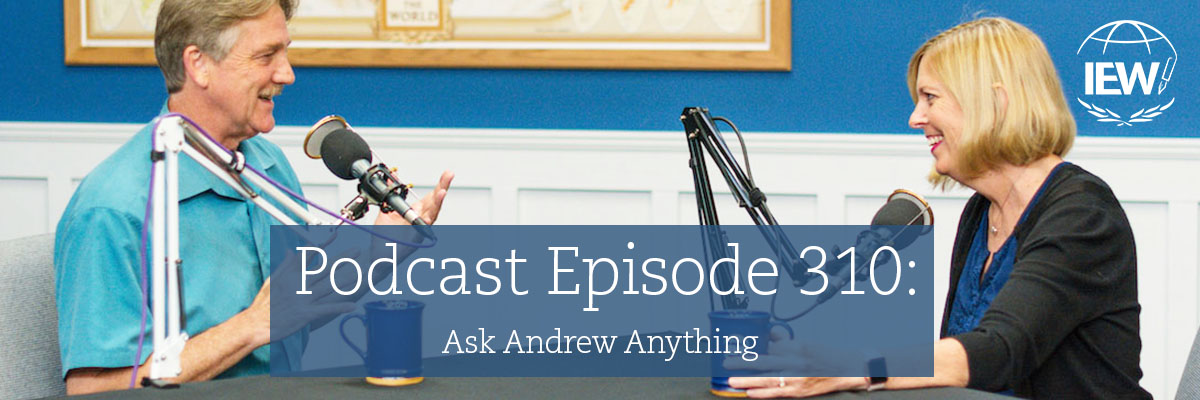
It’s that time again! Every tenth podcast is set aside so that listeners can “ask Andrew anything.” In podcast Episode 310 listeners asked the following questions: How do I know if I’m expecting too... read more

Some people collect stamps. Others search out rocks or spoons. I love to collect homophones. First off they’re free for the scooping up. Secondly they make me feel smarter. Finally they don’t need... read more

“Our mission is to equip teachers and teaching parents with methods and materials which will aid them in training their students to become confident and competent communicators and thinkers.” Partnering with parents and... read more

As we seek to teach stylistic techniques to our students, it is easy to search for ways to streamline the process. One of these temptations is the worksheet. Filled with practice sentences and... read more
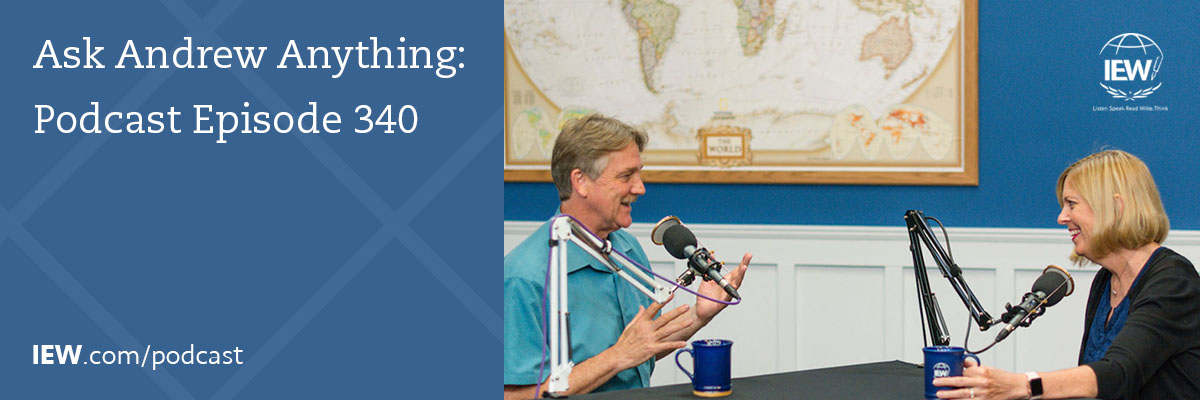
Another ten episodes have been recorded and launched, which means it’s time for another “Ask Andrew Anything!” This series is an opportunity for Andrew to directly answer questions posed by our podcast listeners.... read more
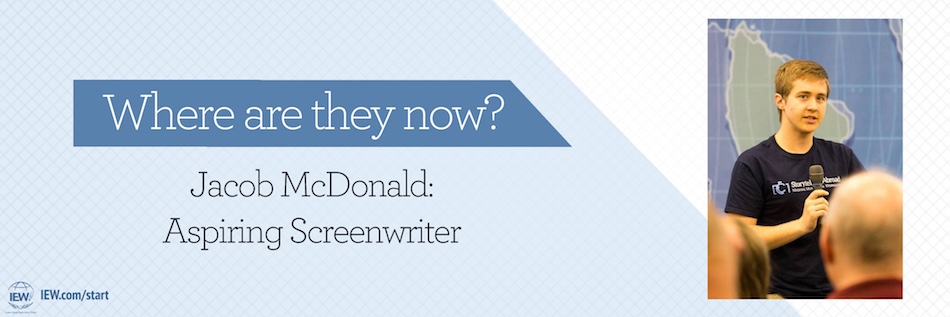
Thanks to IEW and the Student Writing Intensive courses, which teach you how to write, not just what to write, I am able to express myself through my passion—screenwriting. IEW alum Jacob McDonald is a college student from... read more

In the first blog post dedicated to suffixing, I addressed the dropping rule. This rule essentially states that one should drop the final nonsyllabic (silent) e before applying a vowel suffix. There are... read more

It was a classic mid-spring semester burnout. Cold and cloudy got me feeling uninspired and unprepared, to the point I found myself intently hoping that the roads would be icy enough to provide... read more
As we seek to teach stylistic techniques to our students, it is easy to search for ways to streamline the process. One of these temptations is the worksheet. Filled with practice sentences and... read more

Doldrums. The word describes a feeling of lassitude or torpor and was derived from an area called the doldrums, located around the equator. Having very little air movement, sailing vessels can sometimes become... read more

Have you been trekking along with us as we have spent the year focusing on how to think? It has been an amazing journey full of insightful podcasts and blog posts, all focusing... read more
IEW teaches students to write with structure and with style. Style includes vocabulary. Structure is the elements found in compositions. Throughout the year, students progress through nine structural units. Every paper a student... read more

In today’s blog post we welcome guest blogger Mark Baker, co-founder of Christian Homeschool Entrepreneurship, as he shares four important reasons why helping to create an entrepreneurial spirit in your kids is so... read more

Our IEW forum is a robust community of parents, teachers, co-op facilitators, and hybrid school instructors all coming together to support one another in implementing IEW. Every once in a while, a forum... read more

In general, accreditation means official recognition that an individual, program, or institution meets certain established standards of quality. It’s a stamp of approval from an outside authority saying, “Yes, this meets the requirements... read more
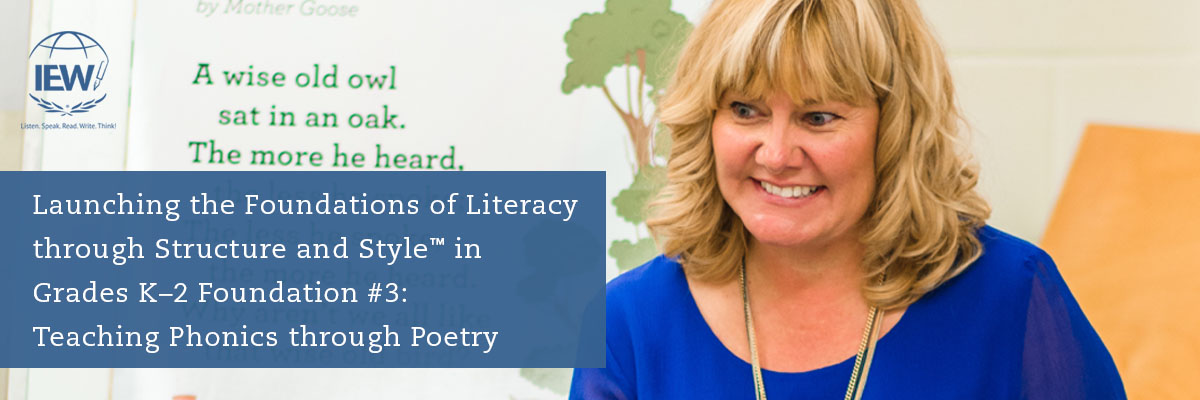
In this blog series, we’ve focused on how the lesson plans in IEW's primary classroom materials use poetry study and memorization as the launching point for building oral language and vocabulary. Poetry is... read more
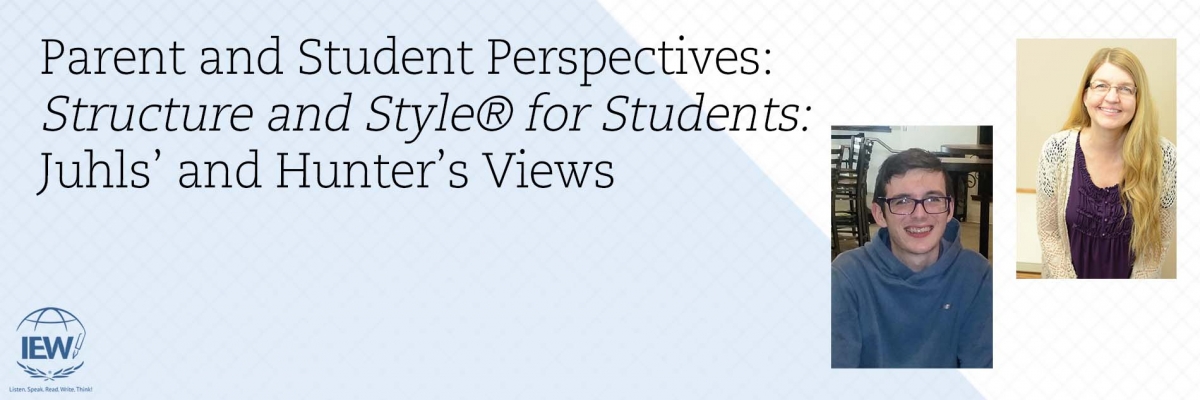
One of the students who participated in Andrew Pudewa’s Level B Structure and Style for Students is Hunter. His mother is Juhls. We recently reached out to the pair to get their thoughts... read more
I am excited to share a new way to use Fix It! Grammar that... read more
Last week we answered some of your general questions about Fix It! Grammar. This week we thought we’d take a closer... read more
Since 2007, teachers and students have delighted in Fix It! Grammar. One of the most appreciated outcomes from using the program... read more
On Day 4 of IEW’s Twelve Days of Christmas Giving, IEW is giving the perfect gift for helping new and veteran... read more
Teachers in school classrooms need opportunities for assessing student growth whether by traditional tests or by some other assessment. Educational assessments... read more
Practice, practice, practice. Mastery of any skill takes practice—lots of it. Musicians repeat scales and basketball players run drills. Until the... read more
Happy New Year! For the first podcast of 2022, Julie Walker invited Denise Kelley into the recording studio to discuss the... read more
Pamela White is IEW’s “grammar guru.” Author of the popular Fix It! Grammar series and IEW’s online department head for Level C... read more
The three R’s—reading, writing, and arithmetic—are generally agreed to be the foundation upon which all other subjects, including science and history,... read more
“Grammar is important. Language should be precise. We must teach it well. However, let us not be confused or distracted by... read more
As educators we have a lot to keep track of. Planning lessons, grading, evaluating progress, and communicating with students and parents... read more
When teachers logged into their IEW® Gradebook accounts this July, one comment summed it up best: “It just keeps getting better!”... read more
Do your students hate grammar? Do they think it’s boring, confusing, or pointless? Do you? If so, I want to recommend... read more
Why watch IEW's parent/teacher training course? Have you ever wondered why IEW’s core product is a parent/teacher training course? Busy homeschoolers often... read more
IEW’s Customer Service team often receives grammar questions from customers. Most often these questions have to do with why something is... read more
If you missed the gifts given for Day 12, you can still access the digital 2023 edition of the Magnum Opus... read more
The English language is a challenging one to learn. This difficulty primarily stems from the fact that English is a melting... read more
This year at IEW, we are focusing on furnishing the mind. Just as we arrange furniture in our homes to create... read more
If you missed the gifts given for Day 4, you can still access these resources: Free Grammar Lessons Podcast Episode 228: The Great... read more
Words are funny little things. Each letter matters. Words that sound alike, called homophones (homo = same, phone = sound), have... read more
“I have come home at last! This is my real country! I belong here. This is the land I have been... read more
As a homeschooling mom, co-op teacher, and now a classroom teacher, I have found that Fix It!™ Grammar is the most... read more
Everyone has opinions about grammar. Because grammar is foundational to writing, IEW is often asked about the teaching of grammar. In... read more
In her 1977 article “Writing as a Mode of Learning,” Janet Emig states, “Writing serves learning uniquely because writing as process-and-product... read more
Earlier this year you sent a box of doughnuts for the staff break room. Now with the end of the school... read more
March is National Grammar month, so for this month we have been highlighting the topic in our blog as well as... read more
Any time or anytime? Every day or everyday? A while or awhile? There are so many of these types of homophones.... read more
Although speaking English comes naturally to most native speakers, writing it can sometimes feel fraught with potential pitfalls. If you have... read more
Over the decades that Andrew Pudewa has been speaking to teachers and parents, he has heard many of them make one... read more
I love the sound of children giggling as they work together to choose a quality adjective or come up with a... read more
Of the skills that produce a well-written essay, IEW’s top two, structure and style, are certainly key linchpins. Equally important, however,... read more
These days, it seems that I am perpetually in my home. I suspect many of us are. Being in my home... read more
Andrew Pudewa is the founder and director of the Institute for Excellence in Writing and has been teaching writing for over... read more
In this week’s podcast, Episode 304, Andrew Pudewa and Julie Walker discuss grammar and its role in the writing process. Relating... read more
Enjoy Jill Pike's concrete response to a parent’s recent request for help regarding the art of invention. Inventive writing is difficult because... read more
In the current episode, podcast Episode 229, of The Arts of Language Podcast, Andrew Pudewa and Julie Walker continue their conversation... read more
The summer months are a period of preparation for educators and teaching parents. Curriculum considerations and decisions dominate during this time.... read more
by Linda Mikottis and Jean Nichols In part one of this series, we described the importance of a multi-sensory approach to language... read more
In Part 1 of this series on IEW’s primary materials, we discussed poetry as a powerful tool in language development, specifically... read more
Look closely at the title. Why is there a colon? How does a colon differ from a semicolon? Fix It! Grammar has... read more
While Andrew was out of the office this past week, Julie invited Denise Kelley into the podcast recording studio. Because Denise... read more
An essential part of using IEW’s stylish sentence openers is knowing when and where to add commas. In response to a... read more
In many ways, the high school years are a staging ground for adulthood. For some students high school represents the culmination... read more
School has started, and Mrs. Jones’s students are steadily improving as they move through the structural units. They’ve also learned the... read more
Many of us have seen the meme, Let’s eat Grandma! It’s a powerful reminder how a tiny little punctuation mark, the... read more
Amy Bell is the founder of Crescenza Studio, where she and a team of teachers offer private tutoring, writing classes, and... read more
Last night we launched our first “Facebook Party,” an event that included over five hundred parents and educators. Andrew Pudewa and... read more
In IEW’s list of stylistic techniques, the first dress-up students learn and practice is the -ly adverb. One of the eight... read more
# Meet Rachel Averitt. Rachel was homeschooled through the sixth grade and then began attending a small Christian school in Oklahoma called Mingo... read more
A common question that IEW’s customer service team receives is “What is the difference between the Structure and Style® for Students... read more
With the final day of IEW’s Twelve Days of Christmas Giving event only recently completed, we wanted to take a moment... read more
# # In our latest podcast, Julie Walker had the opportunity to catch up with Janet Spitler, and that’s no easy feat! Janet... read more
Many of our customers reach out to customer service as their student approaches high school. They want to be sure that... read more
With all that is happening in the world and across the United States, IEW wanted to do what we could to... read more
One of the elements in the stylistic techniques list is the strong verb. A strong verb is a verb that works... read more
With the arrival of June, many parents are beginning to plan in earnest for the upcoming school year. If you have... read more
If you missed the gifts given for Day 9, you can still access these resources: Podcast Episode 333: Letter to the Editor “How... read more
In a blog post last week, I introduced the strong verb dress-up. The third dress-up to be introduced, the strong verb... read more
Administrators, curriculum directors, and schoolteachers often call IEW’s Schools Department asking if our curriculum meets state educational standards. Some schools or... read more
Occasionally we get calls from parents of older children who are just starting out with IEW. They are worried that their... read more
Homophones, words that sound the same but that have different spellings or meanings or both, can be tricky to remember. Some... read more
Students commonly struggle to mark -ing words correctly in papers and in Fix It! Grammar. Students who ask the right questions... read more
Apostrophes are important little punctuation marks. Most people know that they can be used in different ways. For example, one of... read more
IEW® writing method works in a variety of environments. Many students encounter it in their homeschools. Others, though, learn to write... read more
We are thrilled to share with you this fabulous news: High school students can now earn dual credit for both Comp... read more
Teaching writing would be my favorite job if it weren’t for grading. When a student hands in a composition and a... read more
Investing in IEW’s Premium Membership is an investment in yourself as well as your students. Several fabulous perks have been added... read more
In Podcast 164 Andrew Pudewa and Julie Walker began a discussion about the four forms of relevancy. In the first podcast... read more
At IEW we want the courses we provide to be ones that will excite and engage both you and your student.... read more
Which IEW courses will help prepare your students for writing at the collegiate level? Most colleges expect students to be able... read more
We are thrilled to share with you this fabulous news: High school students can now earn dual credit for both Comp... read more
By now you’ve likely heard the buzz about Structure and Style for Students, IEW’s new video-based student course. Every day, our... read more
Lay versus lie. These two verbs perennially perplex even the most astute grammarian in terms of correct usage. Hopefully in today’s... read more
After students learn how to insert a -ly adverb, the next stylistic technique they learn to construct is a who/which clause,... read more
The month of October marks National Learning Disabilities Month as well as Dyslexia Awareness Month. This year on IEW’s blog, we... read more
In June IEW presented its second annual Online Writing Conference. Attended by people from all around the world, the conference offered... read more
We live in a time where there are many options for educating our students. Since the pandemic more and more families... read more
Believe it or not, it is almost time to start back to school. In one form or another, whether it be... read more
It has been a tremendous blessing to have discovered IEW early on in my homeschooling journey. With... read more
Celebrate Episode 500 of the Arts of Language podcast with Andrew Pudewa and Julie Walker. There is so much to celebrate... read more
Behind every great writer is a great editor. This holds true for nearly all great authors, and for us at IEW.... read more
This summer, our IEW team grew by a few more people—college interns who have been helping in a variety of ways... read more
Recently Dr. Nicholas Ellis paid a visit to IEW’s campus in Bixby, Oklahoma. Dr. Ellis is the founder and CEO of... read more
Registration for Fall 2025 opens April 1, 2025. IEW® Online, which started in 2011 with just two instructors and a handful of... read more
As part of IEW’s continued commitment to providing parents and teachers with help for the journey of training students to be... read more
This past Saturday, people from all around the world gathered together virtually to participate in IEW’s online writing conference, From Imitation... read more
Whether you use one of IEW’s Writing Across the Curriculum courses or a Structure and Style® for Students video-based course, it... read more
Whether during summertime or school time, teachers and parents are busy. Inevitably, there’s always another errand to run, room to tidy,... read more
In the somewhat musty memories tucked into the corners of my mind, I can vaguely recall my thoughts about homeschooling before... read more
Our latest “Where Are They Now Student,” Jessica Andress, is a bit of a Renaissance gal. At her young age she... read more
F. Scott Fitzgerald had Maxwell Perkins. For that matter, Ernest Hemingway did as well. Harper Lee had Tay Hohoff. While Fitzgerald,... read more
In teaching we often focus on how or what students write: the correct answer, the polished sentence, the completed paragraph. The... read more
A recent blog post discussed the different functions that a participle ending in -ing can have. More confusion may arise when... read more
In the very first lesson of the very first level of Fix It! Grammar: Level 1 Nose Tree, students are asked... read more
IEW is taught across homes and schools all around the world. Often it is a teacher or parent who guides students... read more
“We now must exhort each other; let us continue to train our students in the use of this great weaponry—the skills... read more
Structure and Style® for Students (SSS) video-based courses build on each other. Although many begin at Level A, older students who... read more
The humble hyphen ( ‐ ) is a subdued punctuation mark indicated by a short dash line. It serves a number... read more
“For there is no doubt that I have lots of words inside me; but at moments, like rush-hour traffic at the... read more
IEW Online classes are a perfect option for students who want to work through the Structure and Style for Students program but... read more
From time to time we enjoy highlighting former structure and style students to showcase their achievements both academically and professionally. Students... read more
Parents and teachers who use IEW’s approach to teaching writing love it. Structure and Style®️ provides the direction and framework, making... read more
Recently in IEW’s official Facebook Group, mom Marcela B. wrote a post in which she explained how valuable she found the... read more
Every year, new words are added to the dictionary. In 2018, for instance, words like “bougie,” “bingeable,” and “predictive” were added... read more
“People laugh at me because I use big words. But if you have big ideas, you have to use big words... read more
Recently we had the opportunity to catch up with one of the Level A Structure and Style Students along with his... read more
As a mom of two students who participated in the filming of IEW’s new Structure and Style Students, Jenny observed first-hand... read more
Value. As professionals and parents, we yearn to find value not only in the way we teach our students, but also... read more
Frederick East Classical, a relatively new homeschool cooperative, is taking central Maryland by storm. In its inaugural year alone, many families... read more
“Wow, that’s a big investment.” Whenever I see this comment online, I am compelled to jump in and offer my story. It... read more
The year 2020 has certainly been extraordinary. In early spring we were plunged into a worldwide pandemic that we are still... read more
“Why do I have to underline the dress-ups?” Any parent or teacher who has used the Structure and Style® methodology for... read more
It is said that English is one of the hardest languages to learn. It breaks its own rules more than it... read more
IEW’s pathway features a great progression of coursework to help your students develop their writing skills, but those are not the... read more
Spring is in the air. How can you tell? Birds are building nests, trees are beginning to bud, and conferences for... read more
For many years there have been two primary diagnostic exams for students preparing to attend college, the SAT® and the ACT®.... read more
Every ten episodes of The Arts of Language Podcast is extra special. On those occasions, Andrew takes the opportunity to answer... read more
Now that we are in the holiday season and are rapidly approaching the mid-point in our school year, it’s a great... read more
My connection with the Lee family began with a phone call. One of IEW’s customer service agents spoke with a woman... read more
by Linda Mikottis and Jean Nichols In the previous post in this series, we compared traditional methods for teaching grammar with those... read more
With podcast Episode 285 Andrew Pudewa concludes recounting the accumulated twenty-year tally of his “Best Book of the Year List.” To... read more
In Andrew’s classroom he requests that his students hire an editor to look over and mark up their rough drafts prior... read more
We recently received this powerful testimonial from Johanna Mackin, a middle school teacher in Murfreesboro, Tennessee. Hoping that it will inspire... read more
As educators continue to adjust to life COVID-19, the difficult reality is that 5-day-a-week traditional schools that were teaching in person... read more
Summer. It’s a season to rest and recover from the hard work of being an educator, right? Whether you are a... read more
On Day 3 of Twelve Days of Christmas Giving, IEW is giving you a three-week sample from Writing Across the Curriculum.... read more
What is an essay? How is it distinguished from a report? Why is it important to teach our students how to... read more
Idioms. We use them in our everyday conversations, but because they are so ingrained into our language structure, we rarely stop... read more
On Day 6 of IEW’s Twelve Days of Christmas Giving, we offer several gifts to help with your youngest learners. Be... read more
On Day 6 of IEW’s Twelve Days of Christmas Giving, we offer several gifts to help with your youngest learners. Be... read more
School’s out! Time to put away the books and forget about school for a few precious, sun-drenched, fun-filled months, right? Wrong!... read more
Which words correctly fill in the blanks? Fifty states ________________ the Union. (compose, comprise) The Supreme Court typically ______________ nine justices. (composes, comprises) Do... read more
It’s that time again! Every tenth podcast is set aside so that listeners can “ask Andrew anything.” In podcast Episode 310... read more
Some people collect stamps. Others search out rocks or spoons. I love to collect homophones. First off they’re free for the... read more
“Our mission is to equip teachers and teaching parents with methods and materials which will aid them in training their students... read more
As we seek to teach stylistic techniques to our students, it is easy to search for ways to streamline the process.... read more
Another ten episodes have been recorded and launched, which means it’s time for another “Ask Andrew Anything!” This series is an... read more
Thanks to IEW and the Student Writing Intensive courses, which teach you how to write, not just what to write, I am able to express... read more
In the first blog post dedicated to suffixing, I addressed the dropping rule. This rule essentially states that one should drop... read more
It was a classic mid-spring semester burnout. Cold and cloudy got me feeling uninspired and unprepared, to the point I found... read more
As we seek to teach stylistic techniques to our students, it is easy to search for ways to streamline the process.... read more
Doldrums. The word describes a feeling of lassitude or torpor and was derived from an area called the doldrums, located around... read more
Have you been trekking along with us as we have spent the year focusing on how to think? It has been... read more
IEW teaches students to write with structure and with style. Style includes vocabulary. Structure is the elements found in compositions. Throughout... read more
In today’s blog post we welcome guest blogger Mark Baker, co-founder of Christian Homeschool Entrepreneurship, as he shares four important reasons... read more
Our IEW forum is a robust community of parents, teachers, co-op facilitators, and hybrid school instructors all coming together to support... read more
In general, accreditation means official recognition that an individual, program, or institution meets certain established standards of quality. It’s a stamp... read more
In this blog series, we’ve focused on how the lesson plans in IEW's primary classroom materials use poetry study and memorization... read more
One of the students who participated in Andrew Pudewa’s Level B Structure and Style for Students is Hunter. His mother is... read more
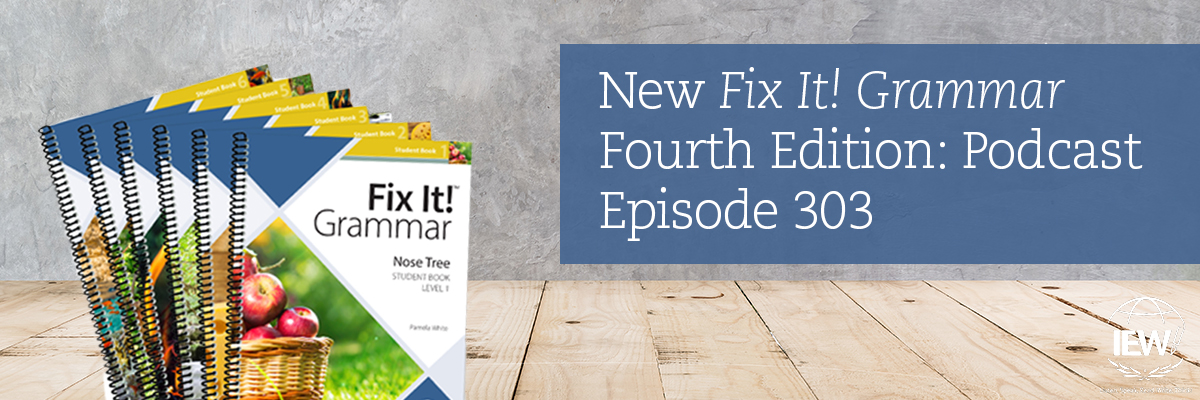
Recently IEW announced the release of the fourth edition of our award-winning Fix It! Grammar program. Because of the release, Julie welcomes Denise Kelley, a good friend and IEW's senior product manager. Join us as Denise shares a bit about her role at IEW, discusses her involvement in the fourth edition of the product, and talks about the improved changes that customers can expect to see in the new edition. You won't want to miss this episode as Julie and Denise even walk through a Fix It! Grammar sentence to show you what fixing sentences is like in the new edition.
Remember to send your questions to Podcast@IEW.com, and perhaps yours will be answered the next time we Ask Andrew Anything (AAA).
If you have any questions about IEW or our products, do not hesitate to contact our Customer Service Team at 800.856.5815 or Info@IEW.com.
Because it's National Grammar Month, Andrew and Julie sit down and have a conversation about grammar. Join us as Andrew and Julie discuss the different divisions of grammar and learn the story behind one of our favorite products: Fix It! Grammar.
Remember to send your questions to Podcast@IEW.com, and perhaps yours will be answered the next time we Ask Andrew Anything (AAA).
If you have any questions about IEW or our products, do not hesitate to contact our Customer Service Team at 800.856.5815 or Info@IEW.com

Why is it important to teach grammar? How does grammar help with comprehension and skills beyond just knowing the parts of speech? Listen as Andrew Pudewa and Julie Walker dive into this valuable subject. Andrew shares a bit of the history behind the Fix It!® Grammar series and talks about why it is an effective method of teaching grammar.
If you have questions for Andrew, send them to podcast@IEW.com
Perhaps your question will be answered at the next Ask Andrew Anything (AAA).
If you have questions about IEW products or classes, contact customer service at 800.856.5815 or info@IEW.com
Grammar is certainly important, but it doesn't guarantee a good writer. Why? This week, Andrew and Julie address the question. Andrew will tell you that grammar is most effective for better writing when taught in the right context and at the right time. Tune in to learn about the value of incorporating grammar instruction within writing assignments, and gain insight on when is a good time to begin teaching grammar. Andrew and Julie will also touch on how Fix It!™ Grammar fits into our methodology. 
Remember to send your questions to Podcast@IEW.com, and perhaps yours will be answered the next time we Ask Andrew Anything (AAA).
If you have any questions about IEW or our products, do not hesitate to contact our Customer Service Team at 800.856.5815 or Info@IEW.com.
Continuing the discussion on grammar, Andrew and Julie steer the conversation towards our program Fix It! Grammar. Join us as the duo explains the approach of the program, and even learn what Andrew suggests after you've completed Book 6! Maybe after Fix-It! Grammar, you'll be able to paraphrase the first sentence of the Declaration of Independence.
Remember to send your questions to Podcast@IEW.com, and perhaps yours will be answered the next time we Ask Andrew Anything (AAA).
If you have any questions about IEW or our products, do not hesitate to contact our Customer Service Team at 800.856.5815 or Info@IEW.com
Can you paraphrase the first sentence of the Declaration of Independence? Without a good grammar foundation, it would be rather challenging. This week Andrew and Julie turn their attention to grammar, specifically its paradoxes and divisions. Tune in and learn the value of grammar as it allows for the accurate transmission of ideas across distance and time.
Remember to send your questions to Podcast@IEW.com, and perhaps yours will be answered the next time we Ask Andrew Anything (AAA).
If you have any questions about IEW or our products, do not hesitate to contact our Customer Service Team at 800.856.5815 or Info@IEW.com

In celebration of National Grammar Day (March 4), Andrew Pudewa and Julie Walker talk with Pamela White about why grammar is important, how it relates to thinking and reading comprehension, and how she came to write the Fix It!® Grammar series. They also address sentence diagramming and why it does not necessarily translate into better grammar skills.
If you have questions for Andrew, send them to podcast@IEW.com
Perhaps your question will be answered at the next Ask Andrew Anything (AAA).
If you have questions about IEW products or classes, contact customer service at 800.856.5815 or info@IEW.com

Continuing the conversation, Andrew Pudewa and Julie Walker ask Pamela White additional questions about the amount of grammar students should study and the benefits to learning grammar in developing thinking skills and reading comprehension. They finish with a discussion of AI tools and why most do not benefit students.
If you have questions for Andrew, send them to podcast@IEW.com
Perhaps your question will be answered at the next Ask Andrew Anything (AAA).
If you have questions about IEW products or classes, contact customer service at 800.856.5815 or info@IEW.com
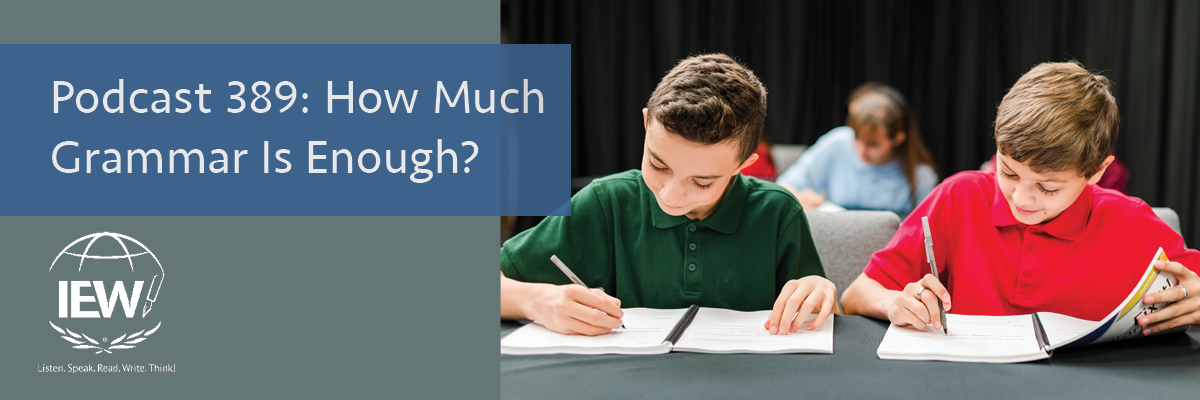
You can’t teach writing for long without people asking, “But what about grammar?” Most people have an extreme opinion about grammar: either start at a very early age and hammer it in year after year or believe that grammar just isn’t that important in our modern world. IEW believes that wisdom is found in the balance between the two. Join Andrew Pudewa and Julie Walker in this week’s podcast as they discuss the importance of grammar and how much is enough.
If you have questions for Andrew, send them to Podcast@IEW.com
Perhaps your question will be answered at the next Ask Andrew Anything (AAA).
If you have questions about IEW products or classes, contact customer service at 800.856.5815 or info@IEW.com
Writing is certainly a complicated process. It's no surprise that many students simply don't enjoy the task. But do they have to? This week, Andrew and Julie address the question. With insight and stories, Andrew discusses how IEW's methodology creates an environment where students strive for excellence, and he talks about the motivation students experience once they are given the tools to succeed.
Remember to send your questions to Podcast@IEW.com, and perhaps yours will be answered the next time we Ask Andrew Anything (AAA).
If you have any questions about IEW or our products, do not hesitate to contact our Customer Service Team at 800.856.5815 or Info@IEW.com
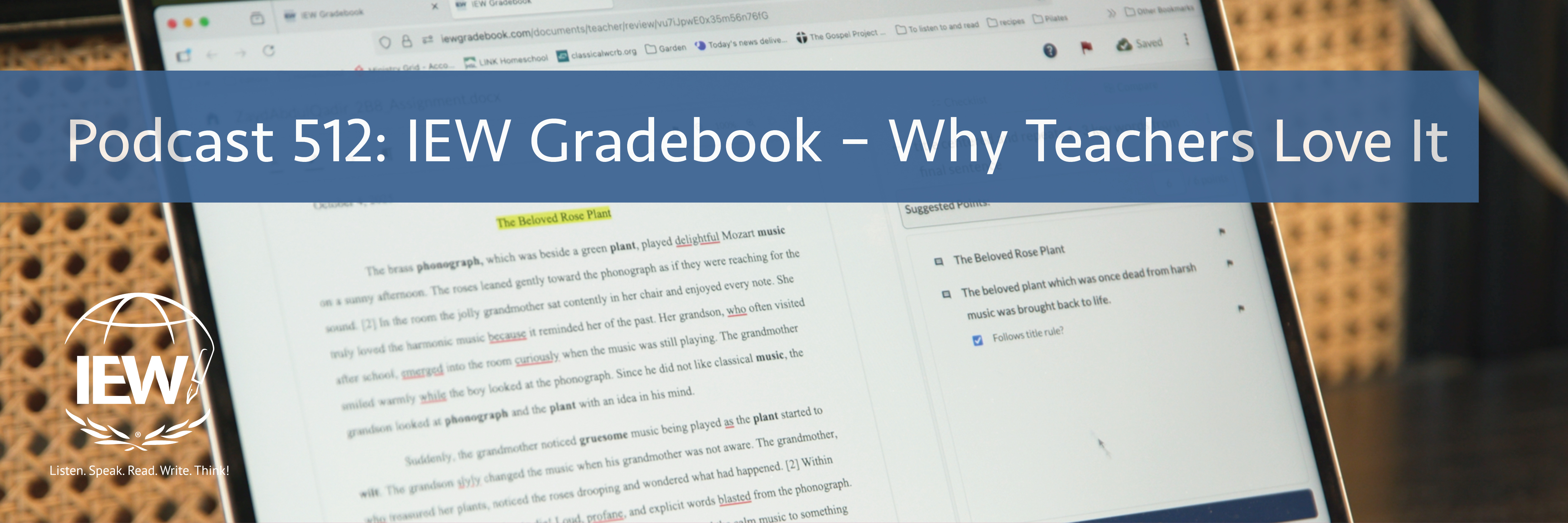
In this episode, Julie Walker interviews Heidi Thomas, the “wizard behind the curtain” who has helped develop IEW® Gradebook as well as many of the Writing Across the Curriculum courses. Heidi shares how IEW Gradebook helps teachers efficiently and effectively grade papers and get their weekends back.
If you have questions for Andrew, send them to podcast@IEW.com
Perhaps your question will be answered at the next Ask Andrew Anything (AAA).
If you have questions about IEW products or classes, contact customer service at 800.856.5815 or info@IEW.com
This is the twelfth episode of twenty-four in the podcast series Reviewing Our Greatest Hits. This show was initially launched on January 5, 2016, as Episode 24.
Andrew and Julie open up their conversation this week by discussing the fading motivation to "do hard things" in our society. With an ever-growing need for proficient communicators, Andrew directs his attention to the importance of cultivating an environment where students strive for excellence and desire to become competent communicators and thinkers.
Remember to send your questions to Podcast@IEW.com, and perhaps yours will be answered the next time we Ask Andrew Anything (AAA).
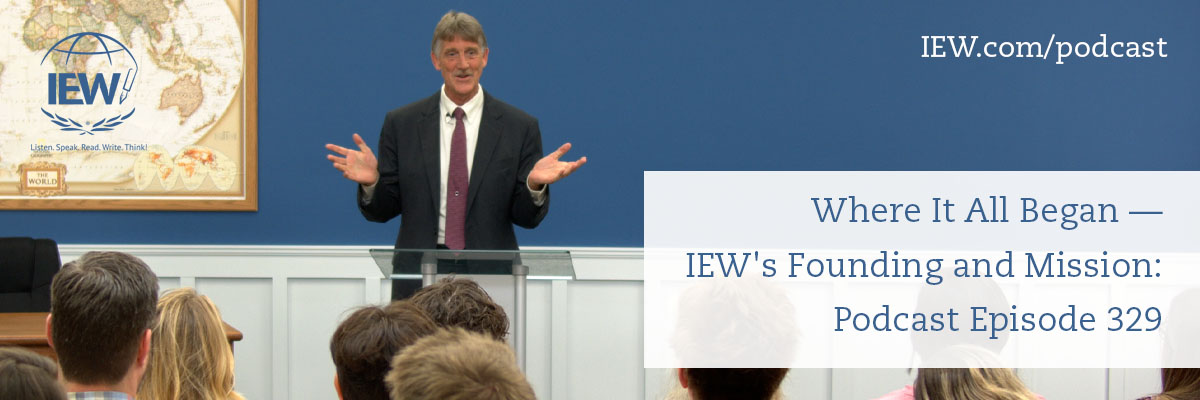
Over the years, IEW has grown tremendously as its writing method is taught in various educational settings. The company offers an abundance of resources, from encouraging blog posts to effective curriculum. How did IEW get to where it is now? This week, Andrew and Julie go back to where it all began and unpack the story of how Andrew discovered the Structure and Style method of teaching writing. Give this episode a listen to learn about the success of the writing method and to understand our mission of equipping teachers and teaching parents.
Remember to send your questions to Podcast@IEW.com, and perhaps yours will be answered the next time we Ask Andrew Anything (AAA).
If you have any questions about IEW or our products, do not hesitate to contact our Customer Service Team at 800.856.5815 or Info@IEW.com.
Are you teaching through Unit 5, Writing from Pictures, and interested to know the ins and outs of the unit? Join Andrew Pudewa in part two of this webinar recording as he discusses the how-to of Unit 5, explaining both the process and purpose of the unit.
Remember to send your questions to Podcast@IEW.com, and perhaps yours will be answered the next time we Ask Andrew Anything (AAA).
If you have any questions about IEW or our products, do not hesitate to contact our Customer Service Team at 800.856.5815 or Info@IEW.com
Often students as well as parents struggle with moving forward on the checklist. In this two-part episode, Andrew provides salient points on the stylistic techniques and offers advice, from being strict with the checklist to not drowning your students with more than they can handle.
Remember to send your questions to Podcast@IEW.com, and perhaps yours will be answered the next time we Ask Andrew Anything (AAA).
If you have any questions about IEW or our products, do not hesitate to contact our Customer Service Team at 800.856.5815 or Info@IEW.com
Outlines, checklists, grammar, oh my! This week, Andrew tackles these topics by answering technical questions submitted by our listeners. Tune in to hear Andrew provide insight on writing the key word outline, and learn the importance of the checklist as it builds mastery over the stylistic techniques.
Remember to send your questions to Podcast@IEW.com, and perhaps yours will be answered the next time we Ask Andrew Anything (AAA).
If you have any questions about IEW or our products, do not hesitate to contact our Customer Service Team at 800.856.5815 or Info@IEW.com.
As the school year fast approaches, many parents are looking for writing instruction for their students. IEW's online classes are a great option! For this podcast episode, Julie welcomes IEW's senior project manager and director of the online class department, Denise Kelley. Denise discusses the high quality of instructors who teach the classes, explains what a typical class day looks like, and talks about the curriculum used. Tune in to learn how the classes give the students an opportunity for a personalized experience with helpful feedback on their writing.
Remember to send your questions to Podcast@IEW.com, and perhaps yours will be answered the next time we Ask Andrew Anything (AAA).
If you have any questions about IEW or our products, do not hesitate to contact our Customer Service Team at 800.856.5815 or Info@IEW.com.
Andrew once again answers just about anything our podcast listeners ask. Tune in to hear Andrew's response to questions on topics like memorization, grammar, and mind mapping.
QUESTIONS ASKED:
1:52 - Ann asks, “I heard Andrew say many times to always spell any word a child asks you to spell. Does he feel the same about math facts? I so commonly hear, ‘Mom, what is six times seven?’ My kids, ages eleven and fourteen, have a difficult time memorizing math facts. They are continuing to improve, but it is quite a process. They have a times table chart to refer to during math and drill math facts. I want them to continue learning new concepts, so often I give them the answer to not muddy the water. I am curious to hear your take on this situation.
7:11 - Jennifer asks, “Teaching class today regarding who/which clauses, I had a parent ask about ‘whose’ and where that fits in the IEW curriculum. For instance: ‘The bicycle whose chain is broken is mine.’”
8:40 - Emily asks, “I have been listening to the podcast and getting prepared all summer. I am telling everyone IEW is my ‘curriculum crush’ of the year! Andrew mentions using this with his dyslexic son. As I recall, he got 20 minutes to copy 100 words and got 1 point per word, but there were also various ways to lose points. Can you explain that?”
16:13 - Anonymous asks, “I have a sixth grader and was wanting to get Linguistic Development through Poetry Memorization, but wasn’t sure whether we should start with Level 1. Will it be as effective as a first grader starting? Is it worth it?”
19:58 - Anonymous asks, “I have a seven-year-old who writes his numbers backwards. He used to write his letters backwards, but that has since been corrected with making them out of clay per the Gift of Dyslexia method. He has made the numbers in clay models too, but the method didn't take with those. Any suggestions for how to help writing with numbers?”
24:27 - Amber asks, “I love the podcast. I am a homeschool mom and have a six-year-old gifted child. She is on the last few lessons of the first Fix It!. We have modified it by having her write the sentence the next day for copywork versus writing the whole paragraph in one day. She completed the PAL writing program at the age of five and writes amazingly well on her own. Should I move her into the second Fix It! right away or switch to traditional copywork?”
27:13 - Janet asks, “What does Andrew say about mind-mapping?”
If you have any questions about IEW or our products, do not hesitate to contact our Customer Service Team at 800.856.5815 or info@IEW.com

Andrew Pudewa and Julie Walker welcome Dr. Nicholas Ellis to this episode. Dr. Ellis is the founder and CEO of Christian Halls International (CHI), an organization that organizes and nurtures local communities for students in higher education programs. In this week’s episode, he discusses the dual enrollment opportunities offered through the partnership between Institute for Excellence in Writing (IEW) and CHI.
If you have questions for Andrew, send them to Podcast@IEW.com
Perhaps your question will be answered at the next Ask Andrew Anything (AAA).
If you have questions about IEW products or classes, contact customer service at 800.856.5815 or info@IEW.com
In this episode, Andrew Pudewa and Julie Walker open the mailbag (or the email inbox) and read letters Andrew has received from students. Listen to this episode to find out from students themselves why they enjoy IEW’s award winning Structure and Style® for Students and Fix It!® Grammar. This episode also features a book authored by a reluctant young writer who changed her mind about writing after learning from Andrew.
If you have questions for Andrew, send them to podcast@IEW.com
Perhaps your question will be answered at the next Ask Andrew Anything (AAA).
If you have questions about IEW products or classes, contact customer service at 800.856.5815 or info@IEW.com

In this Live Ask Andrew Anything episode, Andrew Pudewa and Julie Walker answer questions submitted by listeners. They discuss how to encourage a child to continue practicing a musical instrument, how to help students who are struggling with the questioning skills for Unit 5 and Unit 7, what to do after completing the six books in the Fix It!® Grammar series, what to use for writing a novel, and more. Andrew ends with some letters that he has received from students.
If you have questions for Andrew, send them to podcast@IEW.com
Perhaps your question will be answered at the next Ask Andrew Anything (AAA).
If you have questions about IEW products or classes, contact customer service at 800.856.5815 or info@IEW.com

It’s time for another Live Ask Andrew Anything episode! Join Andrew Pudewa and Julie Walker as they answer questions from listeners. They were joined by Nicki Truesdell, who asked “How much grammar and writing do you think is necessary throughout the years of K-12?” Andrew and Julie also answer questions about Structure and Style® for Students, The Phonetic Zoo, instructor accreditation, and many others. This episode covers all things IEW!
If you have questions for Andrew, send them to podcast@IEW.com
Perhaps your question will be answered at the next Ask Andrew Anything (AAA).
If you have questions about IEW products or classes, contact customer service at 800.856.5815 or info@IEW.com
.jpg)
In this Live Ask Andrew Anything episode, Andrew Pudewa answers questions submitted by listeners. Andrew, along with Julie Walker, discusses how to implement IEW if the parent has learning differences, whether a formal spelling curriculum is needed, how to differentiate the roles of editor and grader, and other questions. Andrew shares anecdotes from the class he is teaching with his grandchildren and their friends and provides encouragement for new-to-IEW moms!

If you have questions for Andrew, send them to podcast@IEW.com
Perhaps your question will be answered at the next Ask Andrew Anything (AAA).
If you have questions about IEW products or classes, contact customer service at 800.856.5815 or info@IEW.com

“You can’t think a thought if you don’t have the words to think it.” In this episode, Andrew Pudewa and Julie Walker talk about how building vocabulary enhances thinking skills. Throughout IEW’s history, thinking about words and their meanings has been incorporated into nearly all of our courses. Listen as Andrew and Julie discuss how we teach vocabulary and why it is important to teach it in the context of other courses.
If you have questions for Andrew, send them to podcast@IEW.com
Perhaps your question will be answered at the next Ask Andrew Anything (AAA).
If you have questions about IEW products or classes, contact customer service at 800.856.5815 or info@IEW.com
Beginning the series on "The Four Deadly Errors of Teaching Writing," Andrew and Julie address the first error: overcorrecting. Listen as Andrew and Julie discuss the negative effect of overcorrecting your student's writing, and stay tuned as Andrew elaborates on how a student's editor should take a "minimalist" approach.
Remember to send your questions to Podcast@IEW.com, and perhaps yours will be answered the next time we Ask Andrew Anything (AAA).
If you have any questions about IEW or our products, do not hesitate to contact our Customer Service Team at 800.856.5815 or Info@IEW.com
Continuing the Homeschool 101 series, Andrew and Julie welcome homeschool mom, YouTuber, and IEW affiliate Karla Canon. Homeschooling her three children, Karla has witnessed the benefits of home education and enjoys sharing her wisdom with others. In this episode Karla shares how homeschooling has allowed her to individualize education in a way that motivates her children to learn and discusses how IEW has impacted her children's ability to communicate effectively.
Remember to send your questions to Podcast@IEW.com, and perhaps yours will be answered the next time we Ask Andrew Anything (AAA).
If you have any questions about IEW or our products, do not hesitate to contact our Customer Service Team at 800.856.5815 or Info@IEW.com.
In the school system the purpose of studying is often solely to pass a test. Is that really the most valuable form of learning? This week Andrew and Julie discuss the benefits of mastery learning. Tune in to this episode as Andrew shares how repetition and reinforcement empower students to think better, and learn how the mastery of subjects enables students to form skills and apply their knowledge later in life.
Remember to send your questions to Podcast@IEW.com, and perhaps yours will be answered the next time we Ask Andrew Anything (AAA).
If you have any questions about IEW or our products, do not hesitate to contact our Customer Service Team at 800.856.5815 or Info@IEW.com

Renee Cook from the Everyday Homeschool Podcast joins Andrew Pudewa and Julie Walker to talk about adding other creative writing assignments that build on Structure and Style® methods and ideas. Andrew and Julie also address diagramming sentences, motivating a reluctant student, and using Structure and Style for Students in a dual enrollment course. Be sure to listen for encouragement and ideas as you start a new school year.
If you have questions for Andrew, send them to podcast@IEW.com
Perhaps your question will be answered at the next Ask Andrew Anything (AAA).
If you have questions about IEW products or classes, contact customer service at 800.856.5815 or info@IEW.com
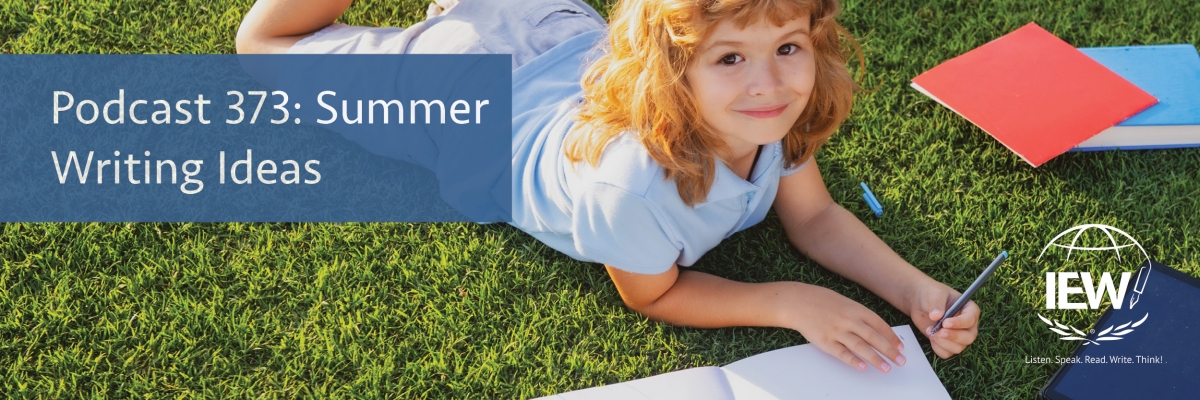
As the school year winds down and summer approaches, parents may be pondering strategies to enrich their students’ writing. Summer is a great time to take a break from regularly scheduled academics and embrace new activities to retain or expand writing skills. In this week’s podcast Andrew Pudewa and Julie Walker suggest some creative ways to do just that.
If you have questions for Andrew, send them to Podcast@IEW.com
Perhaps your question will be answered at the next Ask Andrew Anything (AAA).
If you have questions about IEW products or classes, contact customer service at 800.856.5815 or info@IEW.com
Email, snail mail, mail bag! Once again Andrew and Julie open and read mail sent from students, teachers, and parents. In this delightful episode students share how confident they are since learning IEW's writing method, and teachers and parents express gratitude for the transformation they've witnessed in their students' writing ability. By the way, many of the students wrote their letters using the five-paragraph model!
Remember to send your questions to Podcast@IEW.com, and perhaps yours will be answered the next time we Ask Andrew Anything (AAA).
If you have any questions about IEW or our products, do not hesitate to contact our Customer Service Team at 800.856.5815 or Info@IEW.com
Join us in this enjoyable episode as Andrew and Julie welcome homeschool mom, blogger, and our top affiliate, Erica Arndt. In today's episode Erica describes her life as a homeschooling mom, tells the story of how her blog grew, and provides insight on how to juggle the many responsibilities of teaching your students at home.
Remember to send your questions to Podcast@IEW.com, and perhaps yours will be answered the next time we Ask Andrew Anything (AAA).
If you have any questions about IEW or our products, do not hesitate to contact our Customer Service Team at 800.856.5815 or Info@IEW.com
As a mom, it can be easy to get bogged down and overwhelmed with the busyness of schooling. In this episode Andrew and Julie chat with Kristi Clover, a homeschool mom of five whose goal is to inspire women with "simple solutions for a more joy-filled life." Join us as Kristi shares her tips on getting organized and offers advice on bringing joy to a mom's crazy, chaotic, but wonderful homeschool life.
DISCOUNT CODE:
Enter coupon code IEW30 during checkout to get $30 off The Ultimate Homeschool Organization eCourse by Kristi Clover. Hurry! The offer ends December 31.
Remember to send your questions to Podcast@IEW.com, and perhaps yours will be answered the next time we Ask Andrew Anything (AAA).
If you have any questions about IEW or our products, do not hesitate to contact our Customer Service Team at 800.856.5815 or Info@IEW.com
Andrew has been going through his top read of each year. But does he have a top read of the decade? He just might! With insight and context Andrew and Julie continue down the list of Andrew's top reads from the years 2013 through 2020. Since Andrew hasn't picked his top read of 2021, he instead talks about books that have helped shape his health and well-being during this year.
Remember to send your questions to Podcast@IEW.com, and perhaps yours will be answered the next time we Ask Andrew Anything (AAA).
If you have any questions about IEW or our products, do not hesitate to contact our Customer Service Team at 800.856.5815 or Info@IEW.com
It's that time again when Julie tries to stump Andrew with questions submitted by our listeners. How do I start with IEW? How do I deal with students that use stylistic techniques awkwardly? In this Ask Andrew Anything, Andrew provides insight when answering these inquiries and more. Stay tuned until the end to hear Julie ask Andrew some fun questions submitted by our customer service team. By the way, listen for Michelle's question — she stumps Andrew!
Remember to send your questions to Podcast@IEW.com, and perhaps yours will be answered the next time we Ask Andrew Anything (AAA).
If you have any questions about IEW or our products, do not hesitate to contact our Customer Service Team at 800.856.5815 or Info@IEW.com.

While our Homeschool 101 episodes are generally curated for people who are new to or are considering homeschooling, this episode offers wisdom for anyone who is impacting young lives, including teachers, grandparents, siblings, as well as parents. During this episode Andrew Pudewa and Julie Walker explore what this wisdom entails. Andrew outlines two powerful measures to take to help students furnish their minds and cultivate their writing skills.
If you have questions for Andrew, send them to podcast@IEW.com
Perhaps your question will be answered at the next Ask Andrew Anything (AAA).
If you have questions about IEW products or classes, contact customer service at 800.856.5815 or info@IEW.com
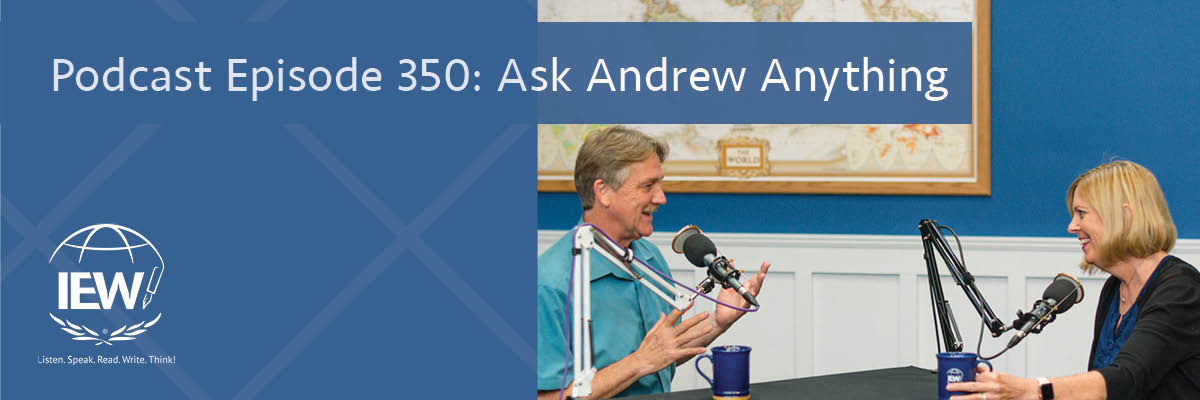
Since 2015 Andrew Pudewa and Julie Walker have been adding to the “Ask Andrew Anything” series. The series is an opportunity for Andrew to respond directly to questions asked by our podcast listeners. This week Andrew offers insight and advice as he answers questions on topics like motivating older students and helping students with learning challenges. Almost all of Andrew’s answers have a common theme: the importance of furnishing the mind through memorized language.
If you have questions for Andrew, send them to podcast@IEW.com
Perhaps your question will be answered at the next Ask Andrew Anything (AAA).
If you have questions about IEW products or classes, contact customer service at 800.856.5815 or info@IEW.com

Join Andrew Pudewa and Julie Walker in this episode to find out if it is really necessary for students to write on paper in 2023. Learn why Andrew advocates for the writing process to include what he calls the “sloppy copy.” Discover how rubrics and checklists take the guesswork out of grading papers. Andrew and Julie offer tips and tricks for correcting and grading papers in a way that is truly helpful to students.
If you have questions for Andrew, send them to podcast@IEW.com
Perhaps your question will be answered at the next Ask Andrew Anything (AAA).
If you have questions about IEW products or classes, contact customer service at 800.856.5815 or info@IEW.com
Last week, Andrew and Julie discussed creating the right listening and speaking environment for English language learners. Continuing the discussion, the duo turn their attention to reading and writing. Discover how reading the studied language helps the learner with organization, learn how key word outlines help to better understand the text, and understand how the checklist enables the learner to recognize parts of speech and style techniques.
Remember to send your questions to Podcast@IEW.com, and perhaps yours will be answered the next time we Ask Andrew Anything (AAA).
If you have any questions about IEW or our products, do not hesitate to contact our Customer Service Team at 800.856.5815 or Info@IEW.com
What motivates anybody to learn? Answering this question, Andrew and Julie begin this two-part series by discussing the four forms of relevancy. Learn the importance of capitalizing on your student's interests, and gain insight on the least effective form: enforced relevancy.
Remember to send your questions to Podcast@IEW.com, and perhaps yours will be answered the next time we Ask Andrew Anything (AAA).
If you have any questions about IEW or our products, do not hesitate to contact our Customer Service Team at 800.856.5815 or Info@IEW.com
With the school year closing and the sun coming out, teachers and students alike enjoy the nice summer break. However, with the cumulative subjects such as music, language, and math, a break is just the thing that allows students to forget all the memorization they had worked so diligently on throughout the year. Join us as Andrew and Julie encourage you to set a little time aside during the summer to continue building that repertoire of mastery in your students.
If you have any questions about IEW or our products, do not hesitate to contact our Customer Service Team at 800.856.5815 or info@IEW.com
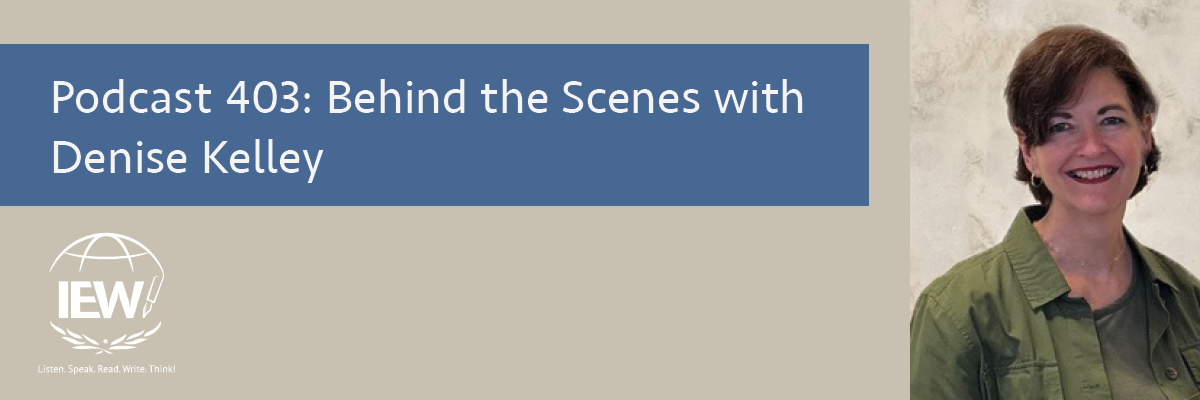
Motivated by a desire to set teachers up for success, Denise Kelley, IEW Manager of Product Development, works tirelessly to ensure all IEW products and services are aligned with the company’s cornerstone product, Teaching Writing: Structure and Style. Join Andrew Pudewa and Julie Walker as they discuss with Denise how her over two decades of experience at IEW have shaped her philosophy of product development.
If you have questions for Andrew, send them to podcast@IEW.com
Perhaps your question will be answered at the next Ask Andrew Anything (AAA).
If you have questions about IEW products or classes, contact customer service at 800.856.5815 or info@IEW.com
To change things up a bit, Andrew and Julie open some mail from our customers and podcast listeners who describe how IEW has helped them in their educational journey. Join Andrew and Julie as they read the letters and express their joy and gratitude.
Remember to send your questions to Podcast@IEW.com, and perhaps yours will be answered the next time we Ask Andrew Anything (AAA).
If you have any questions about IEW or our products, do not hesitate to contact our Customer Service Team at 800.856.5815 or Info@IEW.com
This episode is a recording of Julie Walker presenting the EZ+1: IEW's Step-by-Step Teaching Method webinar. Learning to write is foundational to a child’s education, but for many students it is confusing and frustrating. Likewise, for some teachers, training students in composition can seem overly complex and burdensome. However, teaching students to write well is not only possible, but it can be enjoyable!
If you have questions for Andrew, send them to podcast@IEW.com
Perhaps your question will be answered at the next Ask Andrew Anything (AAA).
If you have questions about IEW products or classes, contact customer service at 800.856.5815 or info@IEW.com
Why is IEW a good fit for students with special needs? This week, Andrew Pudewa and Julie Walker read through testimonials from teaching parents to help answer the question. Tune in to this inspiring episode and learn how IEW's Structure and Style methodology breaks the complex task of writing into small, manageable steps that teach students the process and give them the confidence to succeed.
If you have questions for Andrew, send them to podcast@IEW.com
Perhaps your question will be answered at the next Ask Andrew Anything (AAA).
If you have questions about IEW products or classes, contact customer service at 800.856.5815 or info@IEW.com
With summer just around the corner, many parents and teachers are wondering how to help their students to continue building their writing and thinking skills. Tune in to this week's podcast as Andrew and Julie provide suggestions on how to incorporate and encourage learning in a fun manner throughout the summer.
Remember to send your questions to Podcast@IEW.com, and perhaps yours will be answered the next time we Ask Andrew Anything (AAA).
If you have any questions about IEW or our products, do not hesitate to contact our Customer Service Team at 800.856.5815 or Info@IEW.com
From inspiring to technical, IEW's blogs are here to support and guide teachers and parents and aid students in their educational journey. In this podcast Andrew and Julie welcome the IEW blog "curator," Jennifer Mauser. Enjoy a fun conversation with Jennifer as she explains her role with IEW's blog, and learn about the different content that she publishes on the website.
Remember to send your questions to Podcast@IEW.com, and perhaps yours will be answered the next time we Ask Andrew Anything (AAA).
If you have any questions about IEW or our products, do not hesitate to contact our Customer Service Team at 800.856.5815 or Info@IEW.com
Are you hoping to enrich the time spent with your students at home? Tune in to this week's episode! Andrew and Julie continue the series on homeschooling help. This episode, the duo lays out some practical tips for parents when educating at home. Be encrouaged as Andrew and Julie share the importance of setting realistic expectations and focusing on the main priorites.
Remember to send your questions to Podcast@IEW.com, and perhaps yours will be answered the next time we Ask Andrew Anything (AAA).
If you have any questions about IEW or our products, do not hesitate to contact our Customer Service Team at 800.856.5815 or Info@IEW.com

In this episode, Andrew Pudewa and Julie Walker open the mailbag (or the email inbox) and read letters IEW has received from students, parents, and teachers. Listen to this episode to find out how IEW has assisted refugee students, how teachers are incorporating IEW into their classrooms, and how IEW assists students long after they have completed high school. Often students send Andrew samples of their work, and he shares some excerpts in this podcast.
If you have questions for Andrew, send them to podcast@IEW.com
Perhaps your question will be answered at the next Ask Andrew Anything (AAA).
If you have questions about IEW products or classes, contact customer service at 800.856.5815 or info@IEW.com
This is the third episode of twenty-four in the podcast series, Reviewing Our Greatest Hits. This show was initially launched on November 21, 2018, as Episode 166.
To finish up this conversation on relevancy, Andrew and Julie discuss the last of the four forms of relevancy: contrived relevancy and enforced relevancy. Learn how creating a game can motivate your student to learn, and discover how enforced relevancy is the least effective motivator as it can lead to a dislike for learning.
Remember to send your questions to Podcast@IEW.com, and perhaps yours will be answered the next time we Ask Andrew Anything (AAA).
If you have any questions about IEW or our products, do not hesitate to contact our Customer Service Team at 800.856.5815 or Info@IEW.com
To finish up this conversation on relevancy, Andrew and Julie discuss the last of the Four Forms of Relevancy: Contrived Relevancy and Enforced Relevancy. Learn how creating a game can motivate your student to learn, and discover how Enforced Relevancy is the least effective motivator as it can lead to a dislike for learning.
Remember to send your questions to Podcast@IEW.com, and perhaps yours will be answered the next time we Ask Andrew Anything (AAA).
If you have any questions about IEW or our products, do not hesitate to contact our Customer Service Team at 800.856.5815 or Info@IEW.com
The Arts of Language Podcast is honored to welcome Dr. Nicholas Ellis this week. Dr. Ellis is the founder and CEO of Christian Halls International (CHI), an organization that organizes and nurtures local communities for students in higher education programs. In the episode you'll learn about the inspiring work Dr. Ellis and his organization are doing and IEW's exciting partnership with CHI, in which students can receive college credit for completing Structure and Style for Students Year 1C paired with Fix It! Grammar.

Remember to send your questions to Podcast@IEW.com, and perhaps yours will be answered the next time we Ask Andrew Anything (AAA).
If you have any questions about IEW or our products, do not hesitate to contact our Customer Service Team at 800.856.5815 or Info@IEW.com.

Many of IEW’s podcast episodes in 2023 follow this year’s theme of exploring how IEW can help students with learning differences. Every tenth episode features questions submitted by our podcast listeners. Join us as Julie Walker presents Andrew Pudewa with questions from parents regarding their struggling students. Offering practical tips, he helps equip parents to assist their students in improving their writing and spelling skills.
If you have questions for Andrew, send them to podcast@IEW.com
Perhaps your question will be answered at the next Ask Andrew Anything (AAA).
If you have questions about IEW products or classes, contact customer service at 800.856.5815 or info@IEW.com
If an episode number ends in zero, then that means it's time for another Ask Andrew Anything! Join us this week as Julie asks Andrew questions submitted by our listeners. Pulling from his experience, Andrew provides insightful and informative answers to questions ranging from how to know if you're expecting too much from your student, to how to help when the source text seems overwhelming.
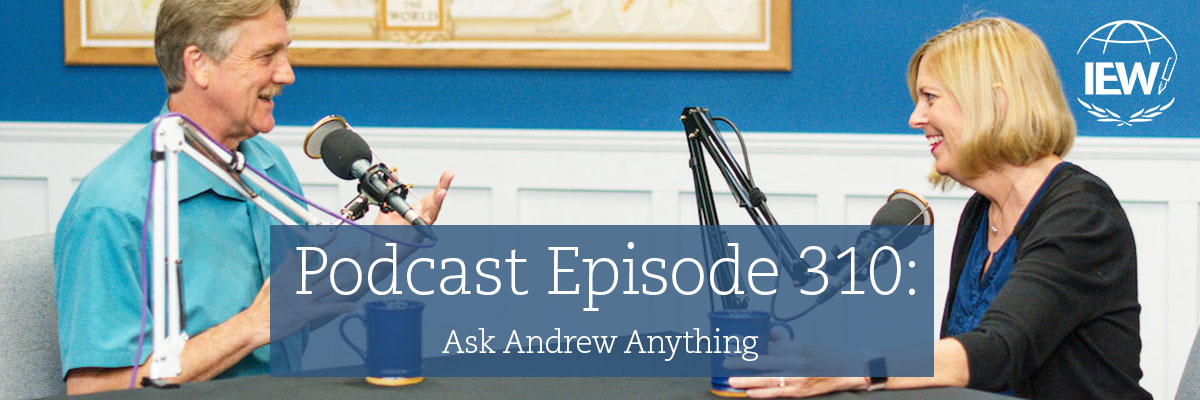
Remember to send your questions to Podcast@IEW.com, and perhaps yours will be answered the next time we Ask Andrew Anything (AAA).
If you have any questions about IEW or our products, do not hesitate to contact our Customer Service Team at 800.856.5815 or Info@IEW.com.
How many total gifts were given in the twelve days of Christmas song? Tune in to find out! In the spirit of Christmas, IEW gives away gifts on each of the days of Christmas, and this week Andrew and Julie share what some of those gifts are this year. We're on Day 3 now, so click the link in the show notes to receive notifications on the gifts each day!
Remember to send your questions to Podcast@IEW.com, and perhaps yours will be answered the next time we Ask Andrew Anything (AAA).
If you have any questions about IEW or our products, do not hesitate to contact our Customer Service Team at 800.856.5815 or Info@IEW.com.
The time is here when Julie asks Andrew just about anything from questions submitted by our listeners. Have you ever wondered what book Andrew would grab off the shelf if the library were about to shut down? Tune in to find out! From questions about banned words to inquiries about finding voice, Andrew provides answers with insight and clarity.
Remember to send your questions to Podcast@IEW.com, and perhaps yours will be answered the next time we Ask Andrew Anything (AAA).
If you have any questions about IEW or our products, do not hesitate to contact our Customer Service Team at 800.856.5815 or Info@IEW.com.
In this podcast Andrew answers questions from our listeners as well as questions our Customer Service Team frequently receives. Join us for another round of inquiries where Andrew offers helpful insight on a variety of topics from how to implement Suzuki method when teaching piano, to how to choose appropriate pieces for copywork.
QUESTIONS ASKED:
1:18 - Jennifer asks, "In Unit 3, I have always found it confusing to list all the characters in the story under Characters and Setting in the key word outline. When we go to write the first paragraph, sometimes including a character that only shows up later in the story is challenging. Is it okay to only mention that character in the Conflict and Problem or Climax and Resolution sections, or is it good to try to mention all the characters in the first paragraph?”
3:25 - Misty asks, “Thanks for the great info! I was listening to the dyslexia podcast. When you talk about a dyslexic child listening to audiobooks, should they be trying to follow along with the print, or just simply listening to the story?”
6:06 - Christine asks, “Should we have commas after an -ly adverb opener?”
8:27 - Amy asks, “My question for you is regarding teaching my kids how to play the piano. I have listened to your podcasts talking about the Suzuki method and it intrigues me. My oldest is taking piano lessons; however, his teacher is retiring soon. She teaches using the traditional method, which is how I was taught piano. The nearest Suzuki teacher is an hour drive away. I’m wondering what your opinion is on a parent attempting to teach the Suzuki method at home. Of course I would read Suzuki’s books to gain better insight, but I wouldn’t have any formal training in the method. Can you help?”
11:52 - Wendy asks, “I am teaching a group of 16 students through the Continuation Course Level B. They are writing papers about famous people from history. The sources that Mr. Pudewa has required them to write are from a book, an encyclopedia/periodical, and whatever other material they might choose such as Internet or video. One of the questions I received was "Can I choose a Kindle book?" This started me questioning what I should allow. Since the filming of the series, much technology has come into play.”
16:37 - Customers frequently ask our Customer Service team, “Prior to Unit 6, how does a student put a word-for-word quotation on the key word outline?”
17:57 - Customers frequently ask our Customer Service team, “When a student with no previous IEW experience begins with High School Essay Intensive and then wants more help with writing, what program would be best to move on to next?”
20:10 - Customers frequently ask our Customer Service team, “What is the purpose of copywork and how do our families and teachers choose the appropriate pieces for students to copy?”
If you have any questions about IEW or our products, do not hesitate to contact our Customer Service Team at 800.856.5815 or info@IEW.com
It's time to open the bag: the mailbag, that is. Wanting to share the love, Andrew and Julie open up letters from teachers and students. Tune in to this gratifying episode during which the duo reads letters in which teachers express how equipped they feel to teach writing after using IEW, and they learn how successful their students have been.
Remember to send your questions to Podcast@IEW.com, and perhaps yours will be answered the next time we Ask Andrew Anything (AAA).
If you have any questions about IEW or our products, do not hesitate to contact our Customer Service Team at 800.856.5815 or Info@IEW.com

In Part 3 of the 500th episode, Andrew Pudewa and Julie Walker reflect on the deeper purpose of the Institute for Excellence in Writing (IEW). They emphasize the accessibility of IEW’s materials and share stories from parents and students illustrating the transformative effects of IEW programs for both homeschoolers and full-time schools. Wrapping up, they reinforce the central idea that IEW is ultimately about teaching students to read, write, speak, and think well—prompting the ongoing question: “What are we really doing here?”
500th Episode Giveaway: Receive a free Portable Walls for Structure and Style Students with coupon code E500-PWSS (for the first 500 customers).
If you have questions for Andrew, send them to podcast@IEW.com
Perhaps your question will be answered at the next Ask Andrew Anything (AAA).
If you have questions about IEW products or classes, contact customer service at 800.856.5815 or info@IEW.com

Andrew Pudewa and Julie Walker are pleased to welcome author Monica Swanson to discuss her newest book, Raising Amazing. In this Arts of Language podcast episode, she shares the insight and wisdom gained parenting four boys. How do you raise children who love God, like their family, and do the dishes without being asked? Her practical advice will enlighten parents with children of all ages.
If you have questions for Andrew, send them to podcast@IEW.com
Perhaps your question will be answered at the next Ask Andrew Anything (AAA).
If you have questions about IEW products or classes, contact customer service at 800.856.5815 or info@IEW.com
† Contains distinctly Christian content
Join us as Andrew discusses his research and cites studies that emphasize the learning differences between boys and girls. Learn how to motivate boys and other active learners by creating relevancy and respecting each child's individual needs.
Remember to send your questions to Podcast@IEW.com, and perhaps yours will be answered the next time we Ask Andrew Anything (AAA).
If you have any questions about IEW or our products, do not hesitate to contact our Customer Service Team at 800.856.5815 or Info@IEW.com
If you have questions for Andrew, send them to podcast@IEW.com
Perhaps your question will be answered at the next Ask Andrew Anything (AAA).
If you have questions about IEW products or classes, contact customer service at 800.856.5815 or info@IEW.com
Answering technical IEW questions ranging from topic/clincher sentences to crash writing courses before college, Andrew provides helpful insight and information about where to start and where to go during this Ask Andrew Anything episode.
3:50 - Kathy asks, "My question is related to a sentence my boy wrote which we couldn't decide if it fits one of the openers. The sentence was along the lines of: 'Found around the North Pole, Beluga whales...'"
8:30 - Cindy asks, "We feel our 6th grade, almost 12-year-old son has had weak writing instruction to this point. He's a voracious reader with great vocabulary and great grades to date, but he has Aspergers and ADHD. We are familiar with your work and are very interested in your online classes as a good way to meet his needs and receive great instruction. I was wondering if you had a good way of determining if we should select Level A or Level B for an online class?"
12:32 - Heidi asks, "I don't think my daughter can handle both Fix It! and the Student Writing Intensive Level A. What should I do first? She is nine and will be in the 4th grade."
14:42 - John asks, "I'm trying to determine the right course for my son, who will be in 9th grade this year. I see that Following Narnia Volume 1 is intended for grades 6–8. However, I believe someone mentioned on the IEW forum that Volume 1 can be adapted to make it appropriate for the High School level. Could you please provide some feedback?"
18:17 - Rebecca asks, "I'm trying to find a writing program for my daughter to use before she goes to college this fall. She has had some writing, but needs to have basic improvement and practice. What do you suggest?"
23:10 - Jacqueline asks, "My daughter is home-schooled and is entering the 9th grade. She writes very well and has not struggled in any area of the programs she has completed. She completed the Student Writing Intensive Level B and will be finishing the Continuation Course Level B in a couple of weeks. She would really like to complete a course geared more toward writing her own books this year. We are wondering if The Elegant Essay or Speech Boot Camp could be swapped out for A Guide to Writing Your Novel?"
Remember to send your questions to Podcast@IEW.com, and perhaps yours will be answered the next time we Ask Andrew Anything (AAA).
If you have any questions about IEW or our products, do not hesitate to contact our Customer Service Team at 800.856.5815 or Info@IEW.com
This week Andrew and Julie are honored to welcome Marie Greenhalgh, the homeschooling mom of an autistic student. After pulling her child out of school, Marie discovered IEW and its methodical step-by-step process. In this episode Marie describes how IEW has helped her student learn, shares her own tips for success, and discusses the importance of not withholding help.
Remember to send your questions to Podcast@IEW.com, and perhaps yours will be answered the next time we Ask Andrew Anything (AAA).
If you have any questions about IEW or our products, do not hesitate to contact our Customer Service Team at 800.856.5815 or Info@IEW.com
As usual, Andrew replies to any question that gets thrown at him. However, in this special edition of "Ask Andrew Anything," Andrew answers questions from our exceptionally experienced online instructors. Learn Andrew's response to questions ranging from where he acquired his sense of humor to advice on explaining dress-up techniques.
QUESTIONS ASKED:
2:16 - Erin Fisher asks, "My students constantly tell me you are so funny. Some of them want to know where do you get your material and who was the funny person that influenced you in your life?"
4:04 - Pamela White asks, "How have your feelings changed over time about the online classes that we offer?"
6:32 - Kim Murphy asks, "One of the common mistakes that I find students making is confusing the strong verb and the quality adjective. Do you have any hints that might help them?"
9:25 - Cathy Flowers asks, "Some of the parents are considering online education and online classes. How are the online classes different than the DVD lessons?"
11:26 - Ginny Lennon asks, "What would you do if all the dress-ups were placed in one sentence?"
13:46 - Robin Osborne asks, "My students love unit 3: Retelling Narrative Stories, but sometimes they have trouble identifying the conflict. What's the best way to figure out the main conflict?"
19:24 - Lizabeth Brasells asks, "What is your favorite style tool and why?"
22:30 - Cinda Tribble asks, "I have some students who love IEW so much and they love the dress-ups that they put in a million -ly words and quality adjectives in one paragraph. Should I limit them or should I allow them to explore?"
26:36 - Denise Kelly asks, "I have some students who would like to know what you like to do in your free time when you're not teaching writing?"
Remember to send your questions to Podcast@IEW.com, and perhaps yours will be answered the next time we Ask Andrew Anything (AAA).
If you have any questions about IEW or our products, do not hesitate to contact our Customer Service Team at 800.856.5815 or Info@IEW.com
Once again, Andrew answers questions from teachers and parents across the country. Whether it be a Latin question or a technical inquiry about sentence openers, Andrew provides helpful insight and clarity. Tune in till the end for an electrifying lightning round, where various students ask questions like "Who is your favorite composer?" and "How many ties do you actually own?"
QUESTIONS ASKED:
1:44 - Sandra asks, "My son was an A student in high school and is doing well enough in college, except for Latin. He took Latin for three years in high school and did fine, but he's taking his second year of Latin in college and it's proving to be excruciating for him. Do you have any advice for this level of Latin?"
4:55 - Christine asks, "Are there a limited number of words that work as invisible openers? For example, "Being exhausted, the man sank down into a sofa." In this example, it works to drop the word "being." Do all words work this way? It doesn't sound right to me to say, "Tired, the man sank down into a sofa." Or, "Sleepy the man..."
8:42 - Holly says, "It would be great to get a little more help or advice on the taking notes from lectures and then writing paragraphs. I'm finding that my son and I are needing more guidance in this area."
11:18 - Leah asks, "I'm interested in one of your courses for my 10th grade daughter. I would like something that she could work on independently. Do you have recommendations? Are there assessments built into the program?"
13:06 - Melissa asks, "I recently listened to episode 66 of the podcast. My son has ADD and learning disabilities such as significant delays in spelling and mild delays in reading and math. He also has delays in working memory and processing speed. He's currently in the 5th grade in a public school. I am unfortunately unable to homeschool him, but we are working with him after school and in the summers as much as possible. I wanted to see what would be recommended for him? He's currently in 5th grade so I'm unsure whether level A or level B would be best for him."
16:13 - Mary asks, "My fourteen-year-old has some issues: lack of proper punctuation in sentences, run-ons, and tense agreements, to name a few. I have addressed these in editing, but I feel like he's missing something pretty important. Should I continue to coach him through editing? He is grasping all the dress-ups quite well. We are in Unit 4."
23:52 - Paula asks,"Hi there. I'm in a bit of a pickle. I am tutoring an IEW writing class at a tutoring center and the grades range from 3-8. The director insists that we use Medieval History-Based Writing Lessons. It's actually been going really well, but now we have started unit 6 and the younger students are confused. Do you have any suggestions?"
Remember to send your questions to Podcast@IEW.com, and perhaps yours will be answered the next time we Ask Andrew Anything (AAA).
If you have any questions about IEW or our products, do not hesitate to contact our Customer Service Team at 800.856.5815 or Info@IEW.com
With seventy-four countries participating, IEW held a virtual writing conference last month. This week, we are posting one of the recordings from that conference. In this recording Andrew and Julie discuss the different ways to teach writing using Structure and Style. Stay tuned until the end, where Andrew provides insightful answers to questions that were submitted live from the audience!
Remember to send your questions to Podcast@IEW.com, and perhaps yours will be answered the next time we Ask Andrew Anything (AAA).
If you have any questions about IEW or our products, do not hesitate to contact our Customer Service Team at 800.856.5815 or Info@IEW.com
Experience excellence in writing as Laura House, IEW's marketing manager, explains IEW's methodology and walks you through both the structure and style of the nine units. With her insightful knowledge and cheery attitude, Laura provides encouragement and demonstrates how you can apply IEW's method to anything you're learning at home or in the classroom.
Remember to send your questions to Podcast@IEW.com, and perhaps yours will be answered the next time we Ask Andrew Anything (AAA).
If you have any questions about IEW or our products, do not hesitate to contact our Customer Service Team at 800.856.5815 or Info@IEW.com
In this episode of "Ask Andrew Anything," IEW's ingenious leader answers questions from our latest Facebook Party, such as "Do you recommend the use of a thesaurus?" and "Is there any creative writing course with IEW?". What would your question be if you could ask Andrew anything?
16:36 - Courtney asks "How long is it okay to scribe for them? I've been following Jill's advice on scribing for them for as long as needed but sometimes it seems as though they will never learn to do it themselves. I am doing U.S History-Based Writing Lessons with my 13 year old dyslexic daughter, along with my 12 year old. Both of them need quite a bit of handholding."
18:19 - Lisa asks "On average how long would you expect it to take a 5th grader to do a key word outline and write there own rough draft from their key word outline? This is out first year with TWSS and it's taking a very long time. Do you ever have students try and write their rough draft from scratch because they can't remember what the key word outline means? What's the best thing to do in this case?"
22:04 - Brandy asks "Is there any creative writing course with IEW? "
29:06- Kristen asked "Our freshman son has some vision issues which delayed his reading and impacted his spelling and writing. We have some of your products. Am I right in thinking slow and steady wins the race or is there something specific I should be doing to help his written communication become easier? "
Remember to send your questions to Podcast@IEW.com, and perhaps yours will be answered the next time we Ask Andrew Anything (AAA).
If you have any questions about IEW or our products, do not hesitate to contact our Customer Service Team at 800.856.5815 or Info@IEW.com
Why learn Latin? So that you can understand all of Andrew's Latin jokes! This week, Andrew and Julie talk about the dead language and discuss the benefits of learning it. Learn how Latin lays the foundation for learning other languages, and gain insight on how it helps in the understanding of English grammar.
Remember to send your questions to Podcast@IEW.com, and perhaps yours will be answered the next time we Ask Andrew Anything (AAA).
If you have any questions about IEW or our products, do not hesitate to contact our Customer Service Team at 800.856.5815 or Info@IEW.com
Have you ever wondered where it all began? Tune into this twenty-fifth birthday celebration recording where Andrew takes you through the history of IEW and expresses his gratitude toward the people that helped him along his journey.
Remember to send your questions to Podcast@IEW.com, and perhaps yours will be answered the next time we Ask Andrew Anything (AAA).
If you have any questions about IEW or our products, do not hesitate to contact our Customer Service Team at 800.856.5815 or Info@IEW.com

In this episode, Andrew Pudewa and Julie Walker address questions from our listeners as well as questions that have been sent to our customer service team. The questions include whether IEW helps with specific mnemonics for writing, whether IEW methods provide scaffolding, and what to do when you take the month of December off. Andrew also reads some of the mail that he has received from students. Julie ends with a question about what kinds of books to read, and Andrew’s answer may surprise you.
If you have questions for Andrew, send them to podcast@IEW.com
Perhaps your question will be answered at the next Ask Andrew Anything (AAA).
If you have questions about IEW products or classes, contact customer service at 800.856.5815 or info@IEW.com
It seems that many people are natural-born spellers while others are not. Either way, Andrew and Julie discuss the importance of mastery through repetition when it comes to the subject. Referring to The Phonetic Zoo, Andrew and Julie talk about the history of the program and share the benefits of an auditory-based spelling program.
Remember to send your questions to Podcast@IEW.com, and perhaps yours will be answered the next time we Ask Andrew Anything (AAA).
If you have any questions about IEW or our products, do not hesitate to contact our Customer Service Team at 800.856.5815 or Info@IEW.com.
In this edition of Ask Andrew Anything, Andrew answers questions from school teachers and parents such as "What can I do to avoid teacher's burnout?" and "Can you please discuss more on character study for reading comprehension and writing?".
Remember to send your questions to Podcast@IEW.com, and perhaps yours will be answered the next time we Ask Andrew Anything (AAA).
If you have any questions about IEW or our products, do not hesitate to contact our Customer Service Team at 800.856.5815 or Info@IEW.com

In this Live Ask Andrew Anything episode, Andrew Pudewa and Julie Walker answer questions submitted by listeners. Listen as they discuss how to find the literature suggestions in IEW’s courses, how to decide what courses to use first with younger students, why the levels of some of the theme-based books have changed, what books Andrew is reading now, and more!
If you have questions for Andrew, send them to podcast@IEW.com
Perhaps your question will be answered at the next Ask Andrew Anything (AAA).
If you have questions about IEW products or classes, contact customer service at 800.856.5815 or info@IEW.com
It’s here! After many months we are proud to introduce our newest video product, Introduction to Public Speaking! In this program middle and high school students learn memory and delivery techniques for five different types of speeches, tips on where to stand and where to look, and other valuable skills for becoming confident verbal communicators. Join Andrew Pudewa and Julie Walker as they elaborate on the new Introduction to Public Speaking.
If you have questions for Andrew, send them to podcast@IEW.com
Perhaps your question will be answered at the next Ask Andrew Anything (AAA).
If you have questions about IEW products or classes, contact customer service at 800.856.5815 or info@IEW.com
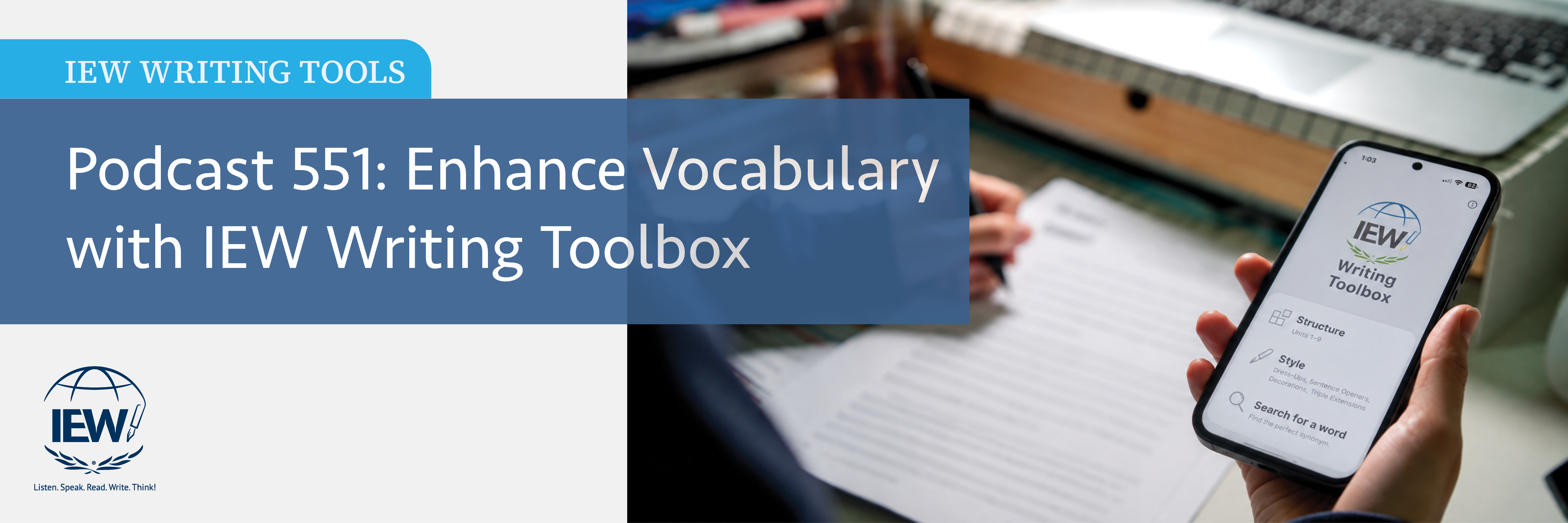
“We want kids to have access to wordlists because. . . when . . . they see a word, ‘Oh, I think I know what that means!’ So it pops off the list, into their eyes, through their brain, out their fingers, and into their paper. It becomes a part of them. This moves the word from a passive vocabulary into an active vocabulary.” This philosophy has influenced many IEW resources. In this episode, Andrew Pudewa and Julie Walker talk about the printed student reference tools we have created and how those have led to the IEW Writing Toolbox app.
If you have questions for Andrew, send them to podcast@IEW.com
Perhaps your question will be answered at the next Ask Andrew Anything (AAA).
If you have questions about IEW products or classes, contact customer service at 800.856.5815 or info@IEW.com

Andrew Pudewa and Julie Walker welcome Dr. Scott Newstok, a professor of English and founding director of the Pearce Shakespeare Endowment at Rhodes College in Memphis, Tennessee. In this podcast they discuss his book How to Think like Shakespeare: Lessons from a Renaissance Education. The discussion centers around how the habits of the mind that shaped the writers, inventors, and thinkers of Shakespeare’s era can apply to education today.
If you have questions for Andrew, send them to podcast@IEW.com
Perhaps your question will be answered at the next Ask Andrew Anything (AAA).
If you have questions about IEW products or classes, contact customer service at 800.856.5815 or info@IEW.com
While you're still in the midst of Unit 5, sail through style with Andrew and Julie as they discuss the different stylistic techniques. Learn about IEW's philosophy of gradually increasing the intensity of the checklist and notice how the checklist allows your students to take ownership of their writing as they discover the world of words.
Remember to send your questions to Podcast@IEW.com, and perhaps yours will be answered the next time we Ask Andrew Anything (AAA).
If you have any questions about IEW or our products, do not hesitate to contact our Customer Service Team at 800.856.5815 or Info@IEW.com
Join us in this podcast as Andrew and Julie sit down and have a conversation about the upcoming school year. Whether you're a full-time schoolteacher or a homeschooling parent, be invigorated in your quest for this new school year as Andrew provides advice on preparing your classroom and encourages you to keep moving forward.
Remember to send your questions to Podcast@IEW.com, and perhaps yours will be answered the next time we Ask Andrew Anything (AAA).
If you have any questions about IEW or our products, do not hesitate to contact our Customer Service Team at 800.856.5815 or Info@IEW.com
This is the nineteenth episode of twenty-four in the podcast series Reviewing Our Greatest Hits. This show was initially launched on January 3, 2018, as Episode 122.
Share the fun and gain some insights as Julie chats with homeschool mom and author Heidi St. John. After homeschooling for many years, Heidi pulled together her experience and wrote The Busy Homeschool Mom's Guide to Romance. Join us as Heidi shares her goal of strengthening families and offers her advice to busy moms who feel overwhelmed with the tasks at hand.
Remember to send your questions to Podcast@IEW.com, and perhaps yours will be answered the next time we Ask Andrew Anything (AAA).
If you have any questions about IEW or our products, do not hesitate to contact our Customer Service Team at 800.856.5815 or Info@IEW.com
What is the art of persuasion, really? Join Andrew and Julie as they hone in on this topic by unpacking the six elements of persuasion, and learn how IEW's Structure and Style method encompasses those elements.
Remember to send your questions to Podcast@IEW.com, and perhaps yours will be answered the next time we Ask Andrew Anything (AAA).
If you have any questions about IEW or our products, do not hesitate to contact our Customer Service Team at 800.856.5815 or Info@IEW.com
While Andrew is away, Julie chats with homeschool mom and author Heidi St. John. After homeschooling for many years, Heidi pulled together her experience and wrote The Busy Homeschool Mom's Guide to Romance. Join us as Heidi shares her goal of strengthening families and offers her advice to busy moms who feel overwhelmed with the tasks at hand.
Remember to send your questions to Podcast@IEW.com, and perhaps yours will be answered the next time we Ask Andrew Anything (AAA).
If you have any questions about IEW or our products, do not hesitate to contact our Customer Service Team at 800.856.5815 or Info@IEW.com
Often students as well as parents struggle with moving forward on the checklist. In this two-part episode, Andrew provides salient points on the stylistic techniques and offers advice, from being strict with the checklist to not drowning your students with more than they can handle.
Remember to send your questions to Podcast@IEW.com, and perhaps yours will be answered the next time we Ask Andrew Anything (AAA).
If you have any questions about IEW or our products, do not hesitate to contact our Customer Service Team at 800.856.5815 or Info@IEW.com
This is the eighth episode of twenty-four in the podcast series Reviewing Our Greatest Hits. This show was initially launched on April 13, 2017, as Episode 89.
Although poetry has been around for many ages, fewer children actually seem to read and appreciate poetry today. Join Andrew and Julie as they unpack the importance of poetry, discuss its components, and address the powerful benefits of reading poetry.
Remember to send your questions to Podcast@IEW.com, and perhaps yours will be answered the next time we Ask Andrew Anything (AAA).
If you have any questions about IEW or our products, do not hesitate to contact our Customer Service Team at 800.856.5815 or Info@IEW.com

In this episode, Andrew Pudewa and Julie Walker discuss how children thrive when parents read aloud to them. Reading aloud builds family bonds and shared memories as well as increases vocabulary and comprehension. Listen to this episode to learn more.
If you have questions for Andrew, send them to podcast@IEW.com
Perhaps your question will be answered at the next Ask Andrew Anything (AAA).
If you have questions about IEW products or classes, contact customer service at 800.856.5815 or info@IEW.com
As teachers and parents it can be challenging to acknowledge that not all children can be taught the same way. In Part 2 of "However Imperfectly," Andrew addresses the importance of adaptability by teaching at the point of need.
Remember to send your questions to Podcast@IEW.com, and perhaps yours will be answered the next time we Ask Andrew Anything (AAA).
If you have any questions about IEW or our products, do not hesitate to contact our Customer Service Team at 800.856.5815 or Info@IEW.com
Andrew Pudewa answers your questions about the difference between editing and grading a paper, what “hands off content” means, and how to help students improve their use of dress-ups and openers at the point of need. Julie Walker ends the episode with a special announcement about an upcoming event, so be sure to listen all the way to the end!
If you have questions for Andrew, send them to podcast@IEW.com
Perhaps your question will be answered at the next Ask Andrew Anything (AAA).
If you have questions about IEW products or classes, contact customer service at 800.856.5815 or info@IEW.com

On November 13, 2023, Andrew Pudewa and Julie Walker celebrated the 400th episode of the Arts of Language podcast by hosting a live event with nearly 400 guests listening. Andrew answered questions from the live audience on topics such as AI, college preparation, and the long-lasting legacy of IEW. He even told a joke. Listen to this extended podcast and hear about new products that IEW will release soon.
If you have questions for Andrew, send them to podcast@IEW.com
Perhaps your question will be answered at the next Ask Andrew Anything (AAA).
If you have questions about IEW products or classes, contact customer service at 800.856.5815 or info@IEW.com
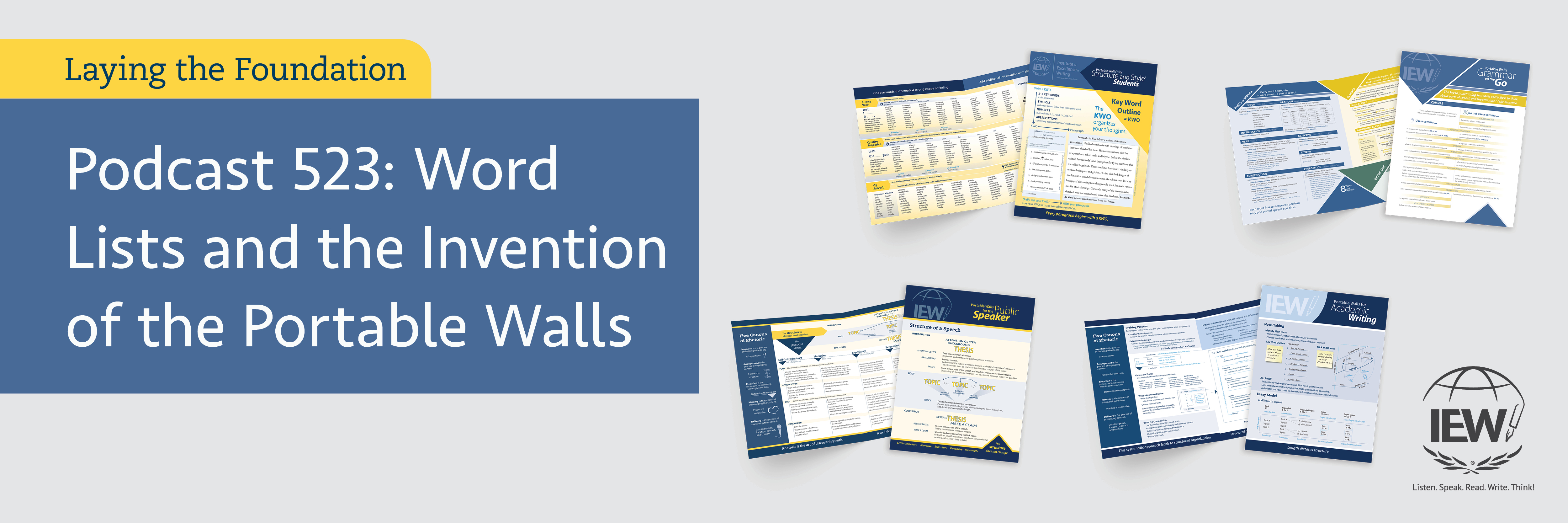
“If the children can’t go to the walls, the walls must come to the children.” Listen to this episode to learn the history of the popular Portable Walls™ products. Andrew Pudewa and Julie Walker share the inspiration behind these handy resources and the variations that have been developed through the years.
If you have questions for Andrew, send them to podcast@IEW.com
Perhaps your question will be answered at the next Ask Andrew Anything (AAA).
If you have questions about IEW products or classes, contact customer service at 800.856.5815 or info@IEW.com
With the rise of technology being used in the classroom, it can be difficult for teachers and parents to determine when it is appropriate to use it. In this episode, Andrew and Julie hone in on the topics and discuss when technology in education makes sense. Learn how technology can enhance the learning experience, but also gain insight on the negative effects it can have if not applied appropriately.
Remember to send your questions to Podcast@IEW.com, and perhaps yours will be answered the next time we Ask Andrew Anything (AAA).
If you have any questions about IEW or our products, do not hesitate to contact our Customer Service Team at 800.856.5815 or Info@IEW.com
“Don’t start a sentence with because!” is a common refrain among teachers. In this episode, Andrew Pudewa and Julie Walker discuss why this word is important and how it fits into IEW’s list of stylistic techniques. Andrew considers how this word promotes thinking and why teaching students to use it provides exercise in overcoming awkwardness in writing. Why else should you listen to this episode? You should listen because you will discover how learning to write actually helps you learn to listen better.
If you have questions for Andrew, send them to podcast@IEW.com
Perhaps your question will be answered at the next Ask Andrew Anything (AAA).
If you have questions about IEW products or classes, contact customer service at 800.856.5815 or info@IEW.com

In this episode, Andrew Pudewa and Julie Walker talk about how the use of AI for writing impacts the process of training students to be critical thinkers. While it may be tempting for students and parents alike to use AI for writing because it is faster and easier, Andrew encourages parents to realize the dangers, including inaccurate facts, imprecise thinking, and unfounded opinions.
If you have questions for Andrew, send them to podcast@IEW.com
Perhaps your question will be answered at the next Ask Andrew Anything (AAA).
If you have questions about IEW products or classes, contact customer service at 800.856.5815 or info@IEW.com

Join Andrew Pudewa and Julie Walker as they bring to light the creative and imaginative aspects of Unit 3: Retelling Narrative Stories. They provide some history of how Unit 3 came about and how it became what it is today. Explore how students of all ages can retell, elaborate, and write variations of fables and short stories while expressing extraordinary creativity.
If you have questions for Andrew, send them to Podcast@IEW.com
Perhaps your question will be answered at the next Ask Andrew Anything (AAA).
If you have questions about IEW products or classes, contact customer service at 800.856.5815 or info@IEW.com

Happy Thanksgiving! In this episode Andrew Pudewa and Julie Walker discuss the power of gratitude. Andrew reads a letter from a student expressing his gratitude for the writing courses. In sharing things they are grateful for, Andrew and Julie encourage listeners to see how simply expressing thanks can change your perspective.
If you have questions for Andrew, send them to podcast@IEW.com
Perhaps your question will be answered at the next Ask Andrew Anything (AAA).
If you have questions about IEW products or classes, contact customer service at 800.856.5815 or info@IEW.com
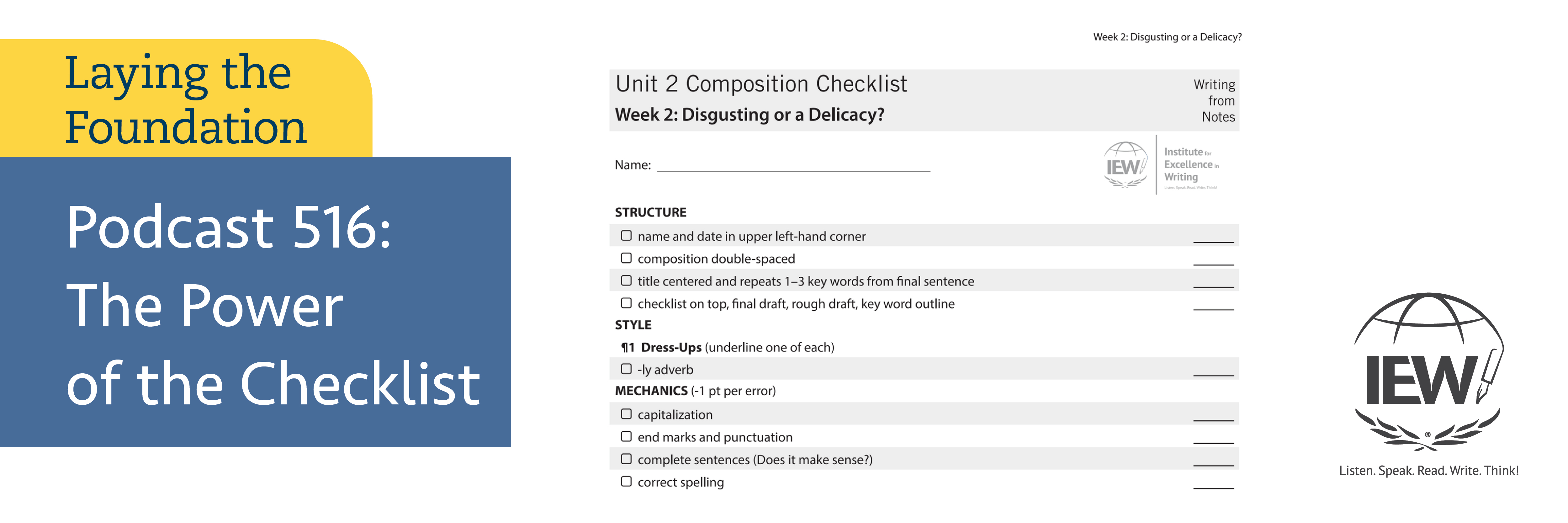
Andrew Pudewa and Julie Walker discuss the history of the IEW’s methodology and how the checklist makes it possible for students to enjoy writing. Julie also shares about the IEW Checklist Generator™, IEW® Gradebook, and instructor accreditation.
If you have questions for Andrew, send them to podcast@IEW.com
Perhaps your question will be answered at the next Ask Andrew Anything (AAA).
If you have questions about IEW products or classes, contact customer service at 800.856.5815 or info@IEW.com

In this episode Andrew Pudewa and Julie Walker reflect on the impact of 2020 and the explosion of homeschooling. Join their conversation as they address some of parents’ most compelling questions when considering homeschooling.
If you have questions for Andrew, send them to podcast@IEW.com
Perhaps your question will be answered at the next Ask Andrew Anything (AAA).
If you have questions about IEW products or classes, contact customer service at 800.856.5815 or info@IEW.com
Having gathered insights and experiences over three decades of teaching, Andrew presents seven lessons he’s learned. These seven lessons are listed in his article, “However Imperfectly,” and in the first chapter of his book of the same title. In part one of this two-part series, Andrew unpacks the first four lessons he’s learned. Andrew notes that while he did not adhere to these principles perfectly over the years, teaching has been well worth it—however imperfectly he may have done it.
Remember to send your questions to podcast@IEW.com, and perhaps yours will be answered the next time we Ask Andrew Anything (AAA).
If you have any questions about IEW or our products, do not hesitate to contact our Customer Service Team at 800.856.5815 or info@IEW.com.
Frustration and tears are things that many students experience when writing. Consequently, it can be difficult for teachers and parents to encourage these students to complete the task. For the next two weeks, Andrew and Julie will discuss how to reach the reluctant writer. To begin the series, Andrew talks about the importance of understanding why your student is reluctant so that you can best address the issue. Then, Andrew and Julie unpack the writing process and explain the power of the key word outline as it helps students separate the complexity of the process.
Remember to send your questions to Podcast@IEW.com, and perhaps yours will be answered the next time we Ask Andrew Anything (AAA).
If you have any questions about IEW or our products, do not hesitate to contact our Customer Service Team at 800.856.5815 or Info@IEW.com

We are wrapping up our year of focusing on how to think. In this episode, Julie Walker asks Andrew Pudewa to share his experience with teaching Unit 5 and how this provides training for the later units. They talk about the history of Unit 5 and how it can help with higher level thinking needed for writing conclusions and critiques. They also discuss how this unit provides a place for students to be a little more creative than the other units and why it fits well as a bit of freedom in the middle of the year.
If you have questions for Andrew, send them to podcast@IEW.com
Perhaps your question will be answered at the next Ask Andrew Anything (AAA).
If you have questions about IEW products or classes, contact customer service at 800.856.5815 or info@IEW.com
In this two-part webinar recording, Andrew and old-time friend and mentor Dr. Webster walk you through Unit 8: Formal Essay Models. Join us as Andrew explains the elements of an essay and discusses what differentiates Unit 8 from the previous units. Additionally, Dr. Webster answers questions and provides suggestions for tackling essay assignments.
5:04 - Melissa asks, "I have a fourteen-year-old, an eleven-year-old, and a nine-year-old all doing the same Student Writing Intensive group B together this year. The nine-year-old loves to write and is keeping up great with the others. Would it be unheard of for all of them to do the Student Continuation Level B together?"
7:24 - Erica says, "My two daughters are struggling with writing the conclusion and introduction paragraphs. We would appreciate more specifics on how to create a great attention-grabbing intro and a thoughtful conclusion."
11:53 - Christi asks, "My oldest, twelve, is a naturally comfortable writer and is beginning to be very resistant to writing outlines in general. Any suggestions on how to continue to help her see why they are important?"
18:59 - Melissa asks, "Do students write them in this order on their first draft then the correct order on the formal draft? Will it be easy for those typing? I wasn't sure on handwritten."
20:19 - Terra asks, "My fifteen-year-old student has been assigned a ten page science paper. I would like to know if you still include the most important and why. Would you state your opinion as an expert without using "I"? How do you write it in a way that keeps it a factual report and not an essay?"
Remember to send your questions to Podcast@IEW.com, and perhaps yours will be answered the next time we Ask Andrew Anything (AAA).
If you have any questions about IEW or our products, do not hesitate to contact our Customer Service Team at 800.856.5815 or Info@IEW.com
How can teachers keep their students motivated in the classroom? For the next two weeks, Andrew and Julie hone in on the topic and discuss classroom management and motivation. In part one of the series, the duo focus on the four forms of relevancy when it comes to motivating students. Tune in to hear Andrew share how capitalizing on your students' interests is an important aspect in keeping them engaged, and learn why enforced relevancy should be avoided as it doesn't nurture a love for learning.
Remember to send your questions to Podcast@IEW.com, and perhaps yours will be answered the next time we Ask Andrew Anything (AAA).
If you have any questions about IEW or our products, do not hesitate to contact our Customer Service Team at 800.856.5815 or Info@IEW.com
In part two of this series, Andrew and Julie discuss the second form of relevancy: Inspired Relevancy. Even if a child does not have an intrinsic interest in something, they can still be inspired to learn about it if someone they love has a genuine interest in it. Discover the different ways students are inspired to learn, and gain some insight on how you can apply that to your students' studies.
Remember to send your questions to Podcast@IEW.com, and perhaps yours will be answered the next time we Ask Andrew Anything (AAA).
If you have any questions about IEW or our products, do not hesitate to contact our Customer Service Team at 800.856.5815 or Info@IEW.com

In this episode Andrew Pudewa and Julie Walker discuss the importance of learning the basic essay model even when many say it is outdated or formulaic. Learn how to take the basic essay model and expand it to a super-essay. Andrew even discusses the name of the longest essay model that uses one of his favorite words.
If you have questions for Andrew, send them to podcast@IEW.com
Perhaps your question will be answered at the next Ask Andrew Anything (AAA).
If you have questions about IEW products or classes, contact customer service at 800.856.5815 or info@IEW.com

If you have been following along all year, we have made it to the final episode in this year’s series on the unit models. Join Andrew Pudewa and Julie Walker as they discuss Unit 9: Formal Critique. In some ways, it is the culmination of all the units. Explore the value of learning the skills of analysis and writing about literature even if students are not planning to pursue a literary career.
If you have questions for Andrew, send them to podcast@IEW.com
Perhaps your question will be answered at the next Ask Andrew Anything (AAA).
If you have questions about IEW products or classes, contact customer service at 800.856.5815 or info@IEW.com

Andrew Pudewa and Julie Walker recorded this two-part podcast at the NCFCA National Championship in St. Paul, Minnesota, in June 2025. They discuss what plagiarism is, why it is easier for students to plagiarize today, and why it is important to avoid plagiarism. Be sure to listen to Part 2 (posts on 9/3) as they discuss some solutions to this problem.
If you have questions for Andrew, send them to podcast@IEW.com
Perhaps your question will be answered at the next Ask Andrew Anything (AAA).
If you have questions about IEW products or classes, contact customer service at 800.856.5815 or info@IEW.com
Recently IEW released its annual magalog, a portmanteau of magazine and catalog. Tune in this week to learn about some of the content inside of this year's magalog. Additionally Andrew and Julie discuss the testimonies featured in the magalog, and Andrew reads letters that he received from students.
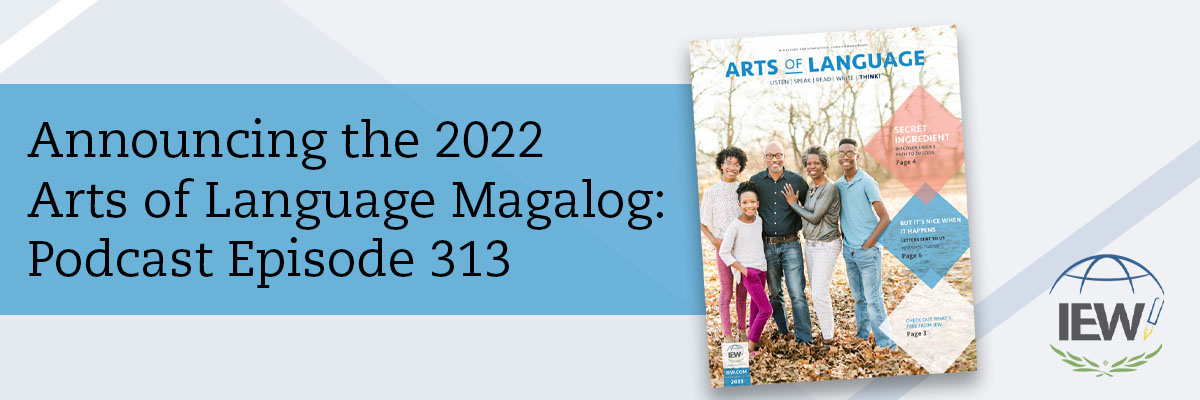
Remember to send your questions to Podcast@IEW.com, and perhaps yours will be answered the next time we Ask Andrew Anything (AAA).
If you have any questions about IEW or our products, do not hesitate to contact our Customer Service Team at 800.856.5815 or Info@IEW.com.
This is the second episode of twenty-four in the podcast series Reviewing Our Greatest Hits. This show was initially launched on November 14, 2018, as Episode 165.
In part two of this series, Andrew and Julie discuss the second form of relevancy: inspired relevancy. Even if children do not have an intrinsic interest in something, they can still be inspired to learn about it if someone they love has a genuine interest in it. Discover the different ways students are inspired to learn, and gain some insight on how you can apply that to your students' studies.
Remember to send your questions to Podcast@IEW.com, and perhaps yours will be answered the next time we Ask Andrew Anything (AAA).
If you have any questions about IEW or our products, do not hesitate to contact our Customer Service Team at 800.856.5815 or Info@IEW.com
This week’s episode is about preventing summer evaporation! Join Andrew Pudewa and Julie Walker as they discuss ideas for summer learning that won’t lead to long faces and complaints. From state history field trips to scavenger hunts, IEW’s customer service team gave Julie a host of ideas for a summer of fun and learning.
If you have questions for Andrew, send them to podcast@IEW.com
Perhaps your question will be answered at the next Ask Andrew Anything (AAA).
If you have questions about IEW products or classes, contact customer service at 800.856.5815 or info@IEW.com

What is media literacy? In this episode Andrew Pudewa and Julie Walker interview Nate Noorlander, who teaches English, history, and philosophy online. They discuss media literacy and its importance in avoiding cynicism and uncertainty in confidently navigating information in the increasingly complex world we live in.
Click the link below for a free session of Media Literacy, including a reflection assignment and an invitation to submit your work.
If you have questions for Andrew, send them to podcast@IEW.com
Perhaps your question will be answered at the next Ask Andrew Anything (AAA).
If you have questions about IEW products or classes, contact customer service at 800.856.5815 or info@IEW.com

In this episode, Andrew Pudewa and Julie Walker talk with Donahue Academy’s Dr. Marc Snyder, principal, and Deacon Edward Watson, assistant principal for curriculum and instruction. They share how and why Donahue Academy has chosen to use IEW, why classical education is growing, and how the IEW Schools Department can assist schools with implementing the Structure and Style® methodology.
If you have questions for Andrew, send them to podcast@IEW.com
Perhaps your question will be answered at the next Ask Andrew Anything (AAA).
If you have questions about IEW products or classes, contact customer service at 800.856.5815 or info@IEW.com
Are there factors that make learning easier? As Andrew notes, “If something is relevant to you, if it is significant, meaningful, useful, interesting, helpful to you, then it is easy to study and learn.” This week Andrew and Julie discuss the four forms of relevancy: intrinsic, inspired, contrived, and enforced. Andrew and Julie dive into these ideas and share how they can be used to help both students and teachers!
If you have questions for Andrew, send them to podcast@IEW.com
Perhaps your question will be answered at the next Ask Andrew Anything (AAA).
If you have questions about IEW products or classes, contact customer service at 800.856.5815 or info@IEW.com
Is IEW for homeschoolers? Or is it for full-time classroom teachers? Does it work well in a hybrid-school model? The short answer is yes! This week, Andrew and Julie unpack how IEW's Structure and Style methodology came to be and discuss how the method of teaching writing is successful in any educational setting.

Remember to send your questions to Podcast@IEW.com, and perhaps yours will be answered the next time we Ask Andrew Anything (AAA).
If you have any questions about IEW or our products, do not hesitate to contact our Customer Service Team at 800.856.5815 or Info@IEW.com.
In a world where everyone has an opinion, it is important to be able to think, listen, analyze, and communicate effectively. This week Andrew and Julie welcome the Director of Education for the National Christian Forensics and Communications Association (NCFCA), Amy Joy Tofte. Join us as Amy Joy discusses the mission of NCFCA, offers insight on the incredible value of speech and debate as it challenges young people to communicate well and pursue truth, and gives us a sneak peek at NCFCA's online events coming up this summer!
Remember to send your questions to Podcast@IEW.com, and perhaps yours will be answered the next time we Ask Andrew Anything (AAA).
If you have any questions about IEW or our products, do not hesitate to contact our Customer Service Team at 800.856.5815 or Info@IEW.com
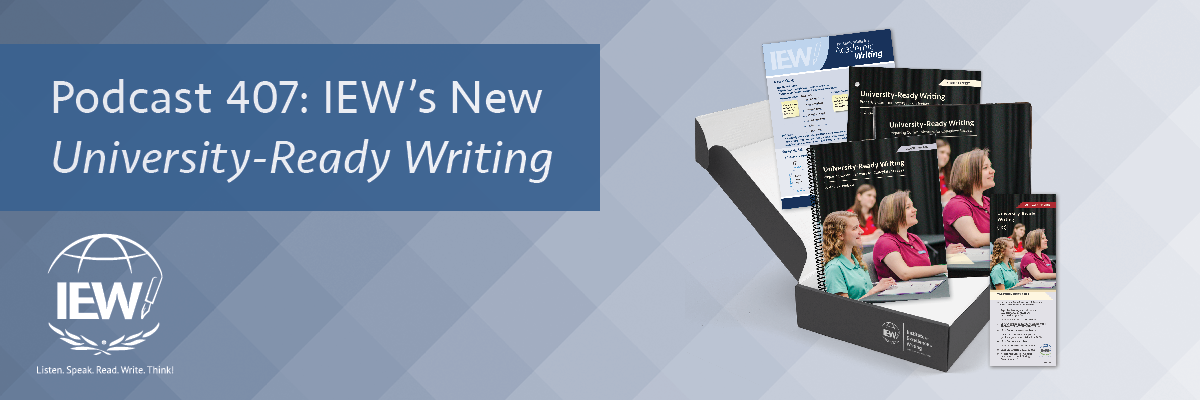
What skills do students need to succeed in collegiate writing? Listen to Andrew Pudewa and Julie Walker discuss this brand new video course that will prepare your high school and college students for college writing. Hear why Andrew would have called this “How to spy on your professor and figure out his or her writing style and imitate it so you can get a better grade on every paper you turn in”!
If you have questions for Andrew, send them to podcast@IEW.com
Perhaps your question will be answered at the next Ask Andrew Anything (AAA).
If you have questions about IEW products or classes, contact customer service at 800.856.5815 or info@IEW.com
For teachers and parents, it can be easy to be concerned about your student meeting the expectations set. In this episode Andrew and Julie address the concern and discuss the different stages of learning for students. Gain insight on how helping them during each stage, whether it be a cute or an awkward phase, is important in developing competent communicators, and learn the importance of believing in and encouraging your students.
Remember to send your questions to Podcast@IEW.com, and perhaps yours will be answered the next time we Ask Andrew Anything (AAA).
If you have any questions about IEW or our products, do not hesitate to contact our Customer Service Team at 800.856.5815 or Info@IEW.com
This is the twenty-third episode of twenty-four in the podcast series Reviewing Our Greatest Hits. This show was initially launched on December 5, 2018, as Episode 168.
In this podcast Andrew and Julie discuss a long-awaited topic: movies. Tune in to hear the duo explore some insights from a few of Andrew's favorite movies.
Remember to send your questions to Podcast@IEW.com, and perhaps yours will be answered the next time we Ask Andrew Anything (AAA).
If you have any questions about IEW or our products, do not hesitate to contact our Customer Service Team at 800.856.5815 or Info@IEW.com
In this podcast Andrew and Julie discuss a long-awaited topic: movies. Tune in to hear the duo explore some insights from a few of Andrew's favorite movies.
Remember to send your questions to Podcast@IEW.com, and perhaps yours will be answered the next time we Ask Andrew Anything (AAA).
If you have any questions about IEW or our products, do not hesitate to contact our Customer Service Team at 800.856.5815 or Info@IEW.com
Andrew Pudewa insists, “If you're ever feeling a little low on hope for the future, get yourself to a speech and debate tournament and just see young people flourishing in every way.” In this episode, learn why he believes this as he and Julie Walker interview three of the NCFCA 2025 Champions: Abbagail Fagot, Pierce Stanton, and Jonathan Paul. These students share how they started with speech and debate, how it prepares them academically, and how it benefitted them in some intangible ways as well.
If you have questions for Andrew, send them to podcast@IEW.com
Perhaps your question will be answered at the next Ask Andrew Anything (AAA).
If you have questions about IEW products or classes, contact customer service at 800.856.5815 or info@IEW.com
When you give your students an assignment, do you do it as well? In today’s episode, Andrew Pudewa and Julie Walker discuss the benefit of occasionally doing the assignment you are giving your students. This principle relates to modeling and imitation, both a part of the foundation of the Structure and Style® method. Listen and be encouraged as Andrew relates the story of when Dr. Webster required him to write the same assignment Andrew had just given to students.
If you have questions for Andrew, send them to podcast@IEW.com
Perhaps your question will be answered at the next Ask Andrew Anything (AAA).
If you have questions about IEW products or classes, contact customer service at 800.856.5815 or info@IEW.com
Andrew Pudewa and Julie Walker are joined by Robert Bortins, CEO of Classical Conversations, to discuss how parental involvement is the best indicator of student success. They talk about the history of American education and the variety of educational options that have become available to parents.
If you have questions for Andrew, send them to podcast@IEW.com
Perhaps your question will be answered at the next Ask Andrew Anything (AAA).
If you have questions about IEW products or classes, contact customer service at 800.856.5815 or info@IEW.com
It’s that time again for Andrew to be asked just about anything from various school teachers and parents across the country. Tune in to hear Andrew’s responses to questions, ranging from advice on encouraging reluctant readers to how to go about correcting students' papers.
QUESTIONS ASKED:
1:36 - Seline asks, "My son is not a fan of reading, but he is not a bad reader, just not motivated. Can you give me some tips to help?
6:52 - Tamara asks, "Are online classes valuable? How does one make the most of them, especially when working with a teen?
10:45 - Rachel asks, "I have an eight-year-old son who is normally congenial. He will consistently tear up and become physically anxious when asked to do something outside of his comfort zone. After encouragement, he will finally attempt whatever was asked of him. I don't think he is purposefully trying to delay, I believe he is actually anxious because he doesn't think he can do it perfectly the first time. He's very bright, but when it comes to writing, he struggles, even with basic copy work. With that background, is there an age where this will be naturally overcome, or is this a matter of mommy needing to train and discipline better?"
18:28 - Sharon asks, "In what order should I help my nine-year-old revise things? If I go over punctuation, spelling, and content, he may just crumble. How do I pick my battles on what to correct?"
22:14 - C.M. asks, "How do you know if your kid genuinely needs to dictate, or would benefit from having to practice getting it from their head to the paper? What skills might they be losing by skipping this?"
Remember to send your questions to Podcast@IEW.com, and perhaps yours will be answered the next time we Ask Andrew Anything (AAA).
If you have any questions about IEW or our products, do not hesitate to contact our Customer Service Team at 800.856.5815 or Info@IEW.com
In this two-part podcast, Andrew reviews the methodology behind and procedure for successfully teaching Unit 3: Retelling Narrative Stories. After a brief overview of the unit, Andrew will walk step-by-step through an assignment, demonstrating Unit 3 methods and concepts for both the teacher/parent and student.
QUESTIONS ASKED:
Remember to send your questions to Podcast@IEW.com, and perhaps yours will be answered the next time we Ask Andrew Anything (AAA).
If you have any questions about IEW or our products, do not hesitate to contact our Customer Service Team at 800.856.5815 or Info@IEW.com
Structure and Style is a registered trademark of the Institute for Excellence in Writing, L.L.C.
For this special edition of the Homeschool 101 episodes, Andrew and Julie are honored to welcome actor, author, and homeschool mom Sam Sorbo. In this episode, Sam talks about her journey to homeschooling, or "self-teaching" as Sam calls it. Sam shares how important it is for students to be given the tools of learning so that they can take ownership of their education. Be encouraged as Sam discusses the most important things to focus on in your home: faith, family, and freedom.
Remember to send your questions to Podcast@IEW.com, and perhaps yours will be answered the next time we Ask Andrew Anything (AAA).
If you have any questions about IEW or our products, do not hesitate to contact our Customer Service Team at 800.856.5815 or Info@IEW.com
Since Andrew can't make it to the mic, IEW's Customer Service Manager Jessica Walker steps up and answers a few of Julie's questions. Learn about Jessica's experience with IEW and listen to Jessica's message on the importance of enjoying this journey of education. Listen until the end to hear what product Jessica will be giving away!
Remember to send your questions to Podcast@IEW.com, and perhaps yours will be answered the next time we Ask Andrew Anything (AAA).
If you have any questions about IEW or our products, do not hesitate to contact our Customer Service Team at 800.856.5815 or Info@IEW.com
"I just can't think of what to write!" Why is it that students have a difficult time making a thought concrete? Tune in as Andrew Pudewa and Julie Walker address this issue, highlight the power of asking questions, and explain the importance of good thinking as it relates to listening, speaking, reading, and writing.
Remember to send your questions to podcast@IEW.com, and perhaps yours will be answered the next time we Ask Andrew Anything (AAA).
If you have any questions about IEW or our products, do not hesitate to contact our Customer Service Team at 800.856.5815 or info@IEW.com

At this time of year, many people take time to reflect. It is through reflection that learning and growing occurs. In this Homeschool 101 episode, Andrew Pudewa and Julie Walker have an inspiring discussion that applies to novice and seasoned homeschoolers alike about the benefits of applying the practice of reflection to homeschooling. They offer several things for parents to consider when they reflect on the last few months of homeschooling.
If you have questions for Andrew, send them to podcast@IEW.com
Perhaps your question will be answered at the next Ask Andrew Anything (AAA).
If you have questions about IEW products or classes, contact customer service at 800.856.5815 or info@IEW.com

In this “While Andrew is Away” episode, Julie Walker is joined by IEW’s Schools Department Manager Jeff Nease. He explains the importance of connecting with an Educational Consultant and staying connected even after the order has been placed. Additionally, he explains how schools use IEW writing courses for student instruction, teacher modeling, and professional development. Jeff wraps up the episode with his personal motivation: “When teachers feel equipped, students flourish.”
If you have questions for Andrew, send them to podcast@IEW.com
Perhaps your question will be answered at the next Ask Andrew Anything (AAA).
If you have questions about IEW products or classes, contact customer service at 800.856.5815 or info@IEW.com
Should writing be confined to a single subject? Andrew and Julie address the question by discussing writing across the curriculum. Whether it be learning about history or studying science, learn how the incorporation of writing across multiple subjects allows for students to be more engaged with the content they're learning and gives them the opportunity for the application of their skills in a variety of ways.
Remember to send your questions to Podcast@IEW.com, and perhaps yours will be answered the next time we Ask Andrew Anything (AAA).
If you have any questions about IEW or our products, do not hesitate to contact our Customer Service Team at 800.856.5815 or Info@IEW.com
After learning the basic five-paragraph essay model, your student can begin to play with it and explore other types of essays. In this podcast Andrew and Julie introduce the advanced essay models. Tune in to hear Andrew walk through the various essay models and learn about the application they have in the real world.
If you have any questions about IEW or our products, do not hesitate to contact our Customer Service Team at 800.856.5815 or info@IEW.com
March forward with Andrew and Julie as you enter into Unit 7: Inventive Writing. This week Andrew and Julie discuss the process of Unit 7 and explore its value in unlocking the student's imagination and pairing it with the thinking skills they have developed. Stay tuned until the end to learn about our writing contest this year as well as the prizes that are awarded to the winners!
If you have any questions about IEW or our products, do not hesitate to contact our Customer Service Team at 800.856.5815 or info@IEW.com
As a student or even a teacher, it can be overwhelming to navigate the amount of sources available for a research paper. In this podcast Andrew Pudewa and Julie Walker discuss Unit 6: Summarizing Multiple References. Join us as Andrew provides tips and suggestions for collecting, organizing, and summarizing facts from multiple references.
Remember to send your questions to podcast@IEW.com, and perhaps yours will be answered the next time we Ask Andrew Anything (AAA).
If you have any questions about IEW or our products, do not hesitate to contact our Customer Service Team at 800.856.5815 or info@IEW.com
Start out strongly this September as Andrew and Julie chat about Units 1 and 2 of the Structure and Style syllabus, laying the foundation for the year. Discover the power of note making and outlining and find out how it paves the path for the upcoming year of writing.
Remember to send your questions to Podcast@IEW.com, and perhaps yours will be answered the next time we Ask Andrew Anything (AAA).
If you have any questions about IEW or our products, do not hesitate to contact our Customer Service Team at 800.856.5815 or Info@IEW.com
While many writing programs begin with a blank page, IEW understands the importance of developing students' thinking skills before asking them to write creatively. In this episode Andrew talks through the ins and outs of Unit 7, Inventive Writing, while explaining the methodology behind it.
Remember to send your questions to Podcast@IEW.com, and perhaps yours will be answered the next time we Ask Andrew Anything (AAA).
If you have any questions about IEW or our products, do not hesitate to contact our Customer Service Team at 800.856.5815 or Info@IEW.com
In November of 2019 IEW released the best thing it has ever done: Structure and Style for Students. Join in on this week's conversation as Andrew and Julie go into the making of the product, and stay tuned to hear the duo's discussion on how it's easy to use, enjoyable, and affordable!
Remember to send your questions to Podcast@IEW.com, and perhaps yours will be answered the next time we Ask Andrew Anything (AAA).
If you have any questions about IEW or our products, do not hesitate to contact our Customer Service Team at 800.856.5815 or Info@IEW.com
This is the tenth episode of twenty-four in the podcast series Reviewing Our Greatest Hits. This show was initially launched on April 18, 2018, as Episode 137.
In part one of this two-part series, Andrew and Julie share a few laughs as they discuss humor in teaching. Learn the powerful health benefits of humor and gain some insight on the positive effects it can have in the classroom, from an increase in student participation to a cultivation of a deeper love of learning.
Remember to send your questions to Podcast@IEW.com, and perhaps yours will be answered the next time we Ask Andrew Anything (AAA).
If you have any questions about IEW or our products, do not hesitate to contact our Customer Service Team at 800.856.5815 or Info@IEW.com
In part one of this two-part series, Andrew and Julie share a few laughs as they discuss humor in teaching. Learn the powerful health benefits of humor and gain some insight on the positive effects it can have in the classroom, from an increase in student participation to a cultivation of a deeper love of learning.
Remember to send your questions to Podcast@IEW.com, and perhaps yours will be answered the next time we Ask Andrew Anything (AAA).
If you have any questions about IEW or our products, do not hesitate to contact our Customer Service Team at 800.856.5815 or Info@IEW.com
With the rise of screens being present in the home, exposure to the outdoors has become limited. Is it possible that our children are suffering from a lack of healthy exposure to the great outdoors? Join us for the next two weeks as Andrew Pudewa and Julie Walker hone in on this topic and discuss the importance being connected to the natural world.
Remember to send your questions to podcast@IEW.com, and perhaps yours will be answered the next time we Ask Andrew Anything (AAA).
If you have any questions about IEW or our products, do not hesitate to contact our Customer Service Team at 800.856.5815 or info@IEW.com
"Sink or swim!" While we all may use the phrase in a comical sense, it simply isn't true. Today, Andrew and Julie turn to the second of the four deadly errors: withholding help. Join the conversation as Andrew and Julie discuss how committing this error actually impedes the development of your student, and learn why students must prove their independence in a skill before a teacher leaves them on their own.
Remember to send your questions to Podcast@IEW.com, and perhaps yours will be answered the next time we Ask Andrew Anything (AAA).
If you have any questions about IEW or our products, do not hesitate to contact our Customer Service Team at 800.856.5815 or Info@IEW.com
Teaching writing to English language learners can present various challenges. This week, Andrew and Julie address the topic and discuss how IEW's Structure and Style methodology positively impacts these students because it separates complexity. Andrew shares encouraging stories from teachers and students about their progress, and gives strategies on creating a successful environment and building the language database.
Remember to send your questions to Podcast@IEW.com, and perhaps yours will be answered the next time we Ask Andrew Anything (AAA).
If you have any questions about IEW or our products, do not hesitate to contact our Customer Service Team at 800.856.5815 or Info@IEW.com
Once Andrew finished the book, he immediately went back to page one and read it again. Which book was it? Tune in to this episode to find out! Starting from 2007, Andrew and Julie continue down the list of Andrew's top book of the year. Andrew will discuss books that helped shape some of his best known talks, and he will also discuss fictional books, emphasizing the value of the genre and the importance of children's literature.
Remember to send your questions to Podcast@IEW.com, and perhaps yours will be answered the next time we Ask Andrew Anything (AAA).
If you have any questions about IEW or our products, do not hesitate to contact our Customer Service Team at 800.856.5815 or Info@IEW.com

Join Andrew Pudewa and Julie Walker for an exciting announcement about a new digital tool—IEW® Writing Companion. They are joined by Heidi Thomas, who worked with Joseph Tabenkin to create IEW® Writing Companion. She describes how IEW Writing Companion solves common problems and provides the assistance that students need to successfully “do what they check and check what they do” as Andrew always encourages. Don’t miss this episode!
If you have questions for Andrew, send them to podcast@IEW.com
Perhaps your question will be answered at the next Ask Andrew Anything (AAA).
If you have questions about IEW products or classes, contact customer service at 800.856.5815 or info@IEW.com

Questions are swirling around the topic of AI and its role in education. Teachers and parents are wondering when and how students should use it and whether using AI is beneficial for students. Join Andrew Pudewa and Julie Walker while they revisit this topic that leads to frequently asked questions as Andrew visits homeschool conventions around the country this summer.
If you have questions for Andrew, send them to podcast@IEW.com
Perhaps your question will be answered at the next Ask Andrew Anything (AAA).
If you have questions about IEW products or classes, contact customer service at 800.856.5815 or info@IEW.com
Join Andrew Pudewa and Nathan King as they interview Jeremy Tate, Founder and CEO of the Classic Learning Test (CLT). Knowing that testing tremendously influences curriculum development in secondary education, Jeremy developed the CLT to connect students with richer, more meaningful content. In the short time of seven years, the CLT has gained tremendous traction. It is now accepted by over two hundred colleges as a complete replacement for the ACT and SAT exams.
If you have questions for Andrew, send them to podcast@IEW.com
Perhaps your question will be answered at the next Ask Andrew Anything (AAA).
If you have questions about IEW products or classes, contact customer service at 800.856.5815 or info@IEW.com
When writers gather information from outside sources, it is important to give credit where credit is due and to cite the sources. Although this is important, learning to cite sources in various formats can be overwhelming, especially for younger students. This week, Andrew Pudewa and Julie Walker welcome IEW's Senior Product Manager, Denise Kelley, to speak about documentation. In this episode Denise discusses how IEW's products utilize the EZ+1 method to teach documentation by gradually teaching students how to cite sources in a step-by-step process.
If you have questions for Andrew, send them to podcast@IEW.com
Perhaps your question will be answered at the next Ask Andrew Anything (AAA).
If you have questions about IEW products or classes, contact customer service at 800.856.5815 or info@IEW.com
"Every child can learn; it all depends on the teacher." Dr. Suzuki truly believed that all children could learn when provided the right conditions. Enjoy a fun and inspiring podcast as Andrew talks about his time studying under Dr. Suzuki in Japan, and gain some insight on Suzuki's methodology.
Remember to send your questions to Podcast@IEW.com, and perhaps yours will be answered the next time we Ask Andrew Anything (AAA).
If you have any questions about IEW or our products, do not hesitate to contact our Customer Service Team at 800.856.5815 or Info@IEW.com
While many writing programs begin with a blank page, IEW understands the importance of developing students' thinking skills before asking them to write creatively. In this episode Andrew talks through the ins and outs of Unit 7, Inventive Writing, while explaining the methodology behind it.
Remember to send your questions to Podcast@IEW.com, and perhaps yours will be answered the next time we Ask Andrew Anything (AAA).
If you have any questions about IEW or our products, do not hesitate to contact our Customer Service Team at 800.856.5815 or Info@IEW.com

Hard Work U® is the motto at College of the Ozarks. Valerie Coleman, director of communications and public relations, and Micah, a public relations major and student working in that office, join Andrew Pudewa and Julie Walker to talk about the unique environment at College of the Ozarks. They discuss how students are able to pay for college by working in many unique venues on campus. Listen to their conversation and share it with any hardworking, college-bound students that you know.
If you have questions for Andrew, send them to podcast@IEW.com
Perhaps your question will be answered at the next Ask Andrew Anything (AAA).
If you have questions about IEW products or classes, contact customer service at 800.856.5815 or info@IEW.com
In honor of Mother's Day, Andrew switches things up and interviews Julie Walker, IEW's Director of Marketing and a longtime friend. After meeting Andrew in 1997, Julie took IEW's methodology and used it to teach her three boys and has since applied it to her own life. Join us for this special episode as Julie discusses her journey to IEW, and be encouraged by Julie's wisdom and advice for all moms out there.
Remember to send your questions to Podcast@IEW.com, and perhaps yours will be answered the next time we Ask Andrew Anything (AAA).
If you have any questions about IEW or our products, do not hesitate to contact our Customer Service Team at 800.856.5815 or Info@IEW.com
As you near the end of the school year, get the information and motivation you need to finish strong with Unit 9: Formal Critiques. In this two-part webinar, Andrew explains the purpose of Unit 9 and how to teach it to your students, walks you through a Unit 9 sample composition, describes the difference between a fiction and a non-fiction critique, and much more.
Remember to send your questions to Podcast@IEW.com, and perhaps yours will be answered the next time we Ask Andrew Anything (AAA).
If you have any questions about IEW or our products, do not hesitate to contact our Customer Service Team at 800.856.5815 or Info@IEW.com

It is time for another Ask Andrew Anything episode! Join us this week as Julie Walker asks Andrew Pudewa questions submitted by our listeners. Along with helpful tips and insightful suggestions on helping students with spelling and poetry writing, Andrew addresses artificial intelligence (AI) writing technology and what parents and teachers need to be aware of.
If you have questions for Andrew, send them to podcast@IEW.com
Perhaps your question will be answered at the next Ask Andrew Anything (AAA).
If you have questions about IEW products or classes, contact customer service at 800.856.5815 or info@IEW.com
IEW’s Fix It!® Grammar has become wildly popular because it does what traditional grammar programs rarely do: it makes grammar stick.
We will have a drawing to see which lucky attendee will win a $29 IEW gift certificate to purchase one level of Fix It! Grammar!
Learning to write is foundational to a child’s education, but for many students it is confusing and frustrating. Likewise, for some teachers, training students in composition can seem overly complex and burdensome. However, teaching students to write well is not only possible, but it can be enjoyable!
Learning to write is foundational to a child’s education, but for many students it is confusing and frustrating. Likewise, for some teachers, training students in composition can seem overly complex and burdensome. However, teaching students to write well is not only possible, but it can be enjoyable!
We will have a drawing to see which lucky attendee will win a $100 IEW gift certificate!
Learning to write is foundational to a child’s education, but for many students it is confusing and frustrating. Likewise, for some teachers, training students in composition can seem overly complex and burdensome. However, teaching students to write well is not only possible, but it can be enjoyable!
We will have a drawing to see which lucky attendee will win a $100 IEW gift certificate!
Learning to write is foundational to a child’s education, but for many students it is confusing and frustrating. Likewise, for some teachers, training students in composition can seem overly complex and burdensome. However, teaching students to write well is not only possible, but it can be enjoyable!
We will have a drawing to see which lucky attendee will win a $100 IEW gift certificate!
Have you heard the buzz about IEW’s Structure and Style for Students? Are you wondering what it’s all about?
Are your students enrolled in a school that presents information and ideas contrary to your personal values? Have you thought that maybe homeschooling is the only viable alternative, but you can’t imagine how you could do it?
“A book report? Noooo!!!” Book reports have the unfortunate reputation of being some of the most boring and overwhelming of any of the writing assignments. Fortunately, that’s because they are rarely approached in the right way. Join Andrew Pudewa as he unpacks the process and answers your questions about teaching Unit 9: Formal Critique, because when kids get to say what they love and hate about something and are equipped to do it well, writing about media is no longer a chore!
Traditional grammar programs systematically teach concepts about grammar, punctuation, and usage with sentences artificially contrived to fit the rules. The theory behind such approaches is that after learning the rules, students will be able to apply them to their own writing. Often these programs teach more concepts than are need-to-know in terms of punctuation, correct grammar, or performance on the ACT or SAT, but they cover the rules well.
Diagramming is a method for helping students grasp the underlying structure of sentences, which is critical for punctuating sentences correctly but which seems to work with only about half the population. Most diagramming programs also teach more than is truly helpful to students learning grammar.
Fix It! Grammar emerged from a teacher's frustration with traditional approaches. Like many teachers, Pamela White (who earned her Master's Degree and A.B.D. in English from Vanderbilt University) recognized that students using traditional grammar programs may learn the rules well but seem to have a disconnect in applying them. The more that grammar is rooted in the writing experience, the better it sticks.
The ultimate goal of teaching grammar should be to train students to be able to edit their own writing effectively. When a side benefit is improved performance on the SAT or ACT, so much the better. Fix It! Grammar (third edition) is a complete grammar program for these goals that truly matter, but it teaches students in the context of writing and through editing rather than through exercises focusing on specific rules.
The early books in Fix It! Grammar begin with marking parts of speech and then identifying phrases (mainly prepositional phrases), main clauses, and dependent clauses. This is better than diagramming because it focuses on the structural parts of sentences that matter most and most affect punctuation rather than getting students bogged down in labeling the parts of sentences that rarely become punctuation hurdles.
Gradually, the Fix It! Grammar stories incorporate usage, grammar, and punctuation concepts, taught by asking students to correct the mistakes in passages and then discuss with their teacher the reasons for corrections.
Early stories have advanced concepts which can be used with stronger students and which pave the way for concepts in later stories.
The six books, each lasting a full year, contain some instruction at the start of each week's lesson as well as added instruction and tips to teachers to use as needed.
All six stories use natural sentences--rather than ones artificially contrived to fit an exercise--that closely mimic the kinds of errors in student writing, so students get repeated practice looking for errors in sentences (the same methods achievement tests use), along with the challenge of needing to explain the why's behind fixes. Since the sentences have the normal complexity of real writing, they also deal with the same issues any writer faces in editing his or her own work.
The primary goal of the Institute for Excellence in Writing is teacher training. We offer lessons and video courses for the student to make the job of the teacher as easy as possible, but it is important for teachers to gain the training necessary to help their children write well.
Writing is an art and requires a give and take between student and teacher. The teacher’s course equips you to provide that for your student. If you only have the student videos, your student will learn a good deal, but will only get the answers to whatever questions were asked when the course was originally recorded. If your student has any difficulty, you may find it challenging to provide him the unique help he needs. The teacher’s course provides all the hows and whys behind the program so that you too can become an accomplished writing teacher over time.
One experienced homeschool mother explains, "I homeschool eight children, so I can appreciate how precious time is, but trying to teach writing without taking the time to watch my teacher’s videos was like pushing the car down the highway because I didn’t have time to stop for gas. :)
You don’t have to watch the entire teacher’s course in one sitting. Just watch a video a month or so and you will do just fine.
As Andrew Pudewa has said, our materials are like ice cream—the more the better! But be sure the first serving is for the teacher.
I remember when I was at a homeschool conference looking at some other writing materials and a very nice Mom poked her head over my shoulder and pointed me to IEW. I glanced at it then, but like you, thought it looked overwhelming.
A year later, I decided to give it a try and I absolutely wish I had done it so much sooner. IEW is not difficult to use or teach, in fact, it's easier and clearer than most of what's out there. The "thought" of it is what can be overwhelming, but the program itself is not complicated. Once you get it, begin using it and learn how to teach writing using IEW - you'll wish you started sooner. Plus, you have this great group for support if you ever have questions!!
Blessings,
Tina
I looked at the website yearly for about 4 years before I finally bought it. Each time I looked at the website I thought, "I can't do this. It looks too hard. It's $269 and I won't be able to do it” Fast forward to the next year and I said the same thing.
Finally this year I decided that all the people I admire that recommend it must have a REASON for liking it so much so I bit the bullet.
Between what is in the plans and the help on the (previous) forum, you won't have to put much effort into lesson planning especially if you have a curriculum you already use. Your son will learn the techniques and then apply them to his regular assignments.
I'm currently working through the student videos with my two oldest. I'm going at our own pace (slower than 1 disc/day MUCH faster than the 15 week lesson plan). And I'm NOT a good lesson planner. I'm happy when I'm convinced they 'get' a topic like the KWO or the dress-ups.
This is NOT hard to teach. It really isn't. If you flip through the tezcher's manual without watching the videos it can look confusing and overwhelming. Once you listen to Andrew explain everything it all makes sense.
Last night, dd (13) thanked me for getting IEW. It is making writing 'fun and much easier' for her. My ds (11) feels the same way. He never put pen to paper before. Now he is doing it, enjoying it and showing a creative side that he never has.
(Name withheld)
The PAL: Reading will require about 30 minutes of your time each day you do it, and another 30-60 minutes of your student’s time to do his things with some, but not always significant, supervision.
The PAL: Writing will take about 30 minutes of your day. It also includes a brief discussion of a story every day. You can use any story you are reading to your child, so it works with anything you are already doing. As with most programs, your first week or two will likely require more time, but as you get it running, it does not take much time to maintain. Using the PAL: Reading, your child will likely be reading after just a few months. At that point, less time will need to be spent on the Reading, so you can spend a little more time on the PAL: Writing Composition section when you get to it. However, it won’t really cost you any more time in the long run.
Yes! Two parents respond to this question below. The first teaches a student with Aspergers (on the autistic scale) and the second has a son who is dyslexic.
Jill states:
"IEW is fantastic for those with expressive disorders. A dear friend of mine has a son with Aspergers. This year, I offered to teach him writing. His mom returned immediately with, 'Oh, he can't write.' I asked for a chance.
"We just started the Student Writing Intensive B. He flew through the first disc, outlined and wrote beautifully. I think he will find the help he needs with this program. I am so happy for him!"
Jen writes:
"My ten year old is dyslexic. Written expression has been a chore for him from day 1. Since we started with IEW two years ago, the lights have come on, and slowly but surely he's become a writer. The logical progression, the straightforward steps and checklists, and the knowledge that he can't 'do it wrong' (there are simply ways that he can 'do it better') have been incredible confidence builders for him.
"IEW has helped him get through the blocks that have always made written communication so difficult for him. Two years ago, he threw a literal screaming fit if I asked him to write his name on his paper...now, he journals a page a day and thinks nothing of writing a paper a week.
"IEW is so customizable (yet makes so much sense to the kids) that it works very, very well for kids that just don't 'get it' otherwise."