
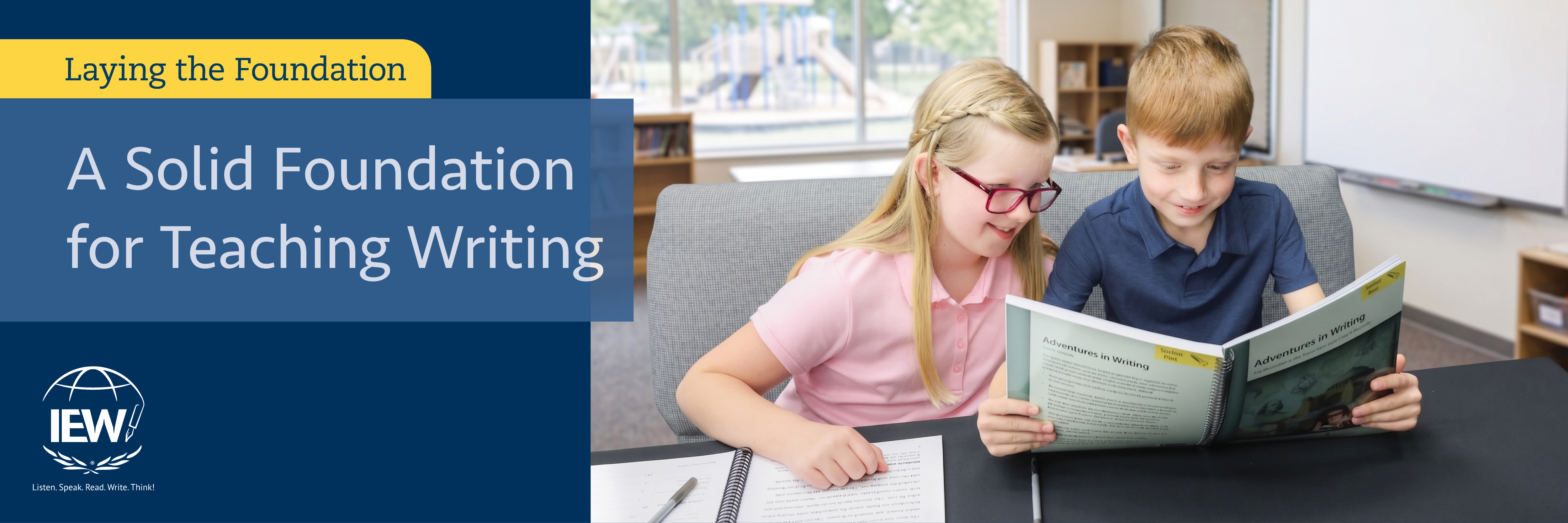
What is the most common complaint from students when they are asked to write something? “I don’t know what to write about.” How does the Structure and Style® method remove this obstacle to learning to write? In every IEW course, students begin by taking notes from included source texts. Using source texts that have been intentionally written for writing instruction sets the Structure and Style method apart from nearly every other writing curriculum. It improves writing instruction by removing obstacles to learning and produces confident writers while it models how to structure sentences and paragraphs and define topics. Additionally, students gain knowledge while they are writing, and their comprehension skills soar.
Beginning with source texts removes the most common obstacle to successful writing instruction and allows students to imitate as they learn. When students do not have to come up with what they are writing about, they are able to focus on learning the skills of composition. They do not have to face a blank page with what seems like a blank brain. Furthermore, quality source texts model correct sentence and paragraph structure that students imitate as they write from their notes.
Imitation is a time-tested method across disciplines. Musicians learn by performing existing music before composing their own. Artists study master paintings before developing personal styles. Athletes drill established techniques before improvising in competition. In carefully written source texts, students encounter strong models of language. Many classical education systems began rhetorical training with retelling and summarizing existing stories. Students learned to handle ideas well before being expected to create entirely original arguments. Modern education sometimes treats imitation as undesirable, but imitation has always been a normal and essential stage of learning.
The source texts included in the Writing Across the Curriculum courses and Structure and Style for Students have clearly defined subjects and paragraph topics. One of the principles taught in Teaching Writing: Structure and Style is one paragraph equals one topic. Many students’ paragraphs lack coherence and clarity because they struggle to identify a narrow topic. When students learn to identify topics in the source texts, they take more focused notes and write more coherent paragraphs almost naturally.
The benefits of using source texts extend beyond structure and into style. A paragraph can be cohesive but boring. When students write from source texts, they are released from the burden of being creative with the content and can play with words. Students may refer to the IEW Writing Tools app, A Word Write Now, or the Portable Walls™ for Structure and Style Students to expand their vocabulary in their writing. With the addition of stylistic techniques, sentence structures become varied and more complex.
Beyond the structure and style in their paragraphs, students gain additional benefits from using source texts. Writing about topics builds background knowledge. As Andrew Pudewa often says, joy and a sense of accomplishment comes from “knowing stuff.” When students study D-Day in history class and later write about it in their writing class, they come to the assignment with some familiarity and then add to their knowledge. They also learn that writing across the curriculum helps them remember what they have previously studied or prepares them to learn about something new. Writing ceases to be its own subject and becomes a tool for learning.
Taking notes from source texts also strengthens comprehension skills as students analyze sentences for main ideas and determine which facts are interesting, important, or relevant to the topic. People are naturally drawn to fascinating details, surprising facts, and memorable stories. When source texts contain vivid or unusual information, students become more engaged. IEW sources are written to capture attention by looking at a topic from a different angle. A source text about the Hagia Sophia becomes more memorable when students discover that a beloved cat once lived there. A lesson about the Mayflower becomes more powerful when students take notes on how cramped and uncomfortable life aboard the ship truly was. Captivating content sparks interest, and interest motivates writing.
Students are not the only ones who benefit from source texts being used in writing instruction. Teachers also find it rewarding. IEW’s Implementation Coach and Schools Department Manager Jeff Nease shared this story in a recent podcast: “I sat in on a third grade class working through Adventures in Writing. As they were talking about Leif Eriksson, they tied it into one of their classmates who was of Norwegian descent, so they did a little case study on the background of names. The teacher said, ‘I never knew writing could be this fun.’ And she really meant it!”
Is there a time to write without provided source texts? Of course! Just as children eventually ride bikes without training wheels, students will locate their own sources for research. In the IEW in Writing series, students use provided sources throughout the units in the earlier books. In Frontiers in Writing and Investigations in Writing, students gather their own sources for the Unit 8 assignment. In Journeys in Writing and Voyages in Writing, students locate their own sources for the second Unit 6 assignment as well as the Unit 8 assignment. Similarly in Structure and Style for Students, students do not begin to locate their own sources until they are older and more experienced writers. Strong writers are not born from unlimited freedom. More often, they are developed through guided practice that gradually builds mastery.
What about those “blank page” assignments that students struggle with? Because students have spent the first six units (often over six months or more) composing paragraphs using provided sources, the blank page assignments are not nearly as daunting. They have learned how to extract information by asking questions while reading a source text. They have learned how to structure sentences and paragraphs. And they have learned how to choose words well. With those skills in place, asking themselves questions about a topic and taking notes in answer to those questions is no longer an obstacle to writing. With confidence, students conquer the blank page without the feeling of a blank brain.
Using provided source texts removes obstacles and builds confidence as students develop composition skills. The gradual process aids students in learning how to define topics to make note making and writing focused. Students discover that writing is not merely about filling a page. As they use provided source texts, they grow in their knowledge and comprehension. Consequently, students thrive with the foundation of the practice IEW sources and the Structure and Style method provide.
by Danielle Olander